Effectiveness of Ergonomics-Based Occupational Health and Safety Assistance on Work Behavior and Welfare of Small-Scale Tofu Industry Workers: A Quasi-Experimental Study
DOI:
https://doi.org/10.31603/nbe21v87Keywords:
Ergonomic, Tofu industry, occupational health and safety, work behavior, quasi-experimentAbstract
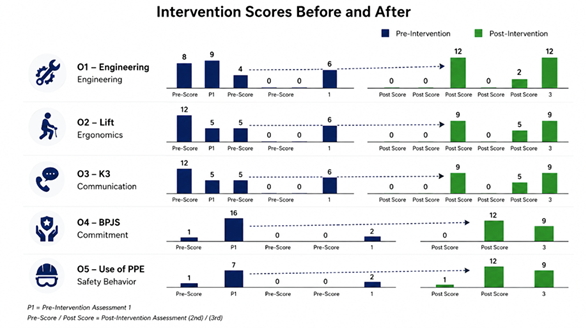
Small-scale tofu manufacturing involves multiple occupational hazards including physical accidents, heat exposure, non-ergonomic working postures, and inadequate personal protective equipment. This study aimed to evaluate the effectiveness of an ergonomics-based occupational health and safety (OHS) assistance program on knowledge, attitude, and actual work behavior among tofu workers in Yogyakarta. A quasi-experimental pre-post design was employed with 17 respondents over a two-month intervention period. Evaluation instruments covered three components: a knowledge test (correct/incorrect), a 5-point Likert attitude scale, and a behavioral observation sheet (1–4 scale) across five OHS indicators. Results showed knowledge improvement from 76.5% to 94.1% (Δ +17.6%). Attitude scores improved significantly (M pre = 18.00 vs. M post = 18.65; t(16) = −2.28, p = .037, Cohen's d = 0.53). The most substantial change occurred in observed work behavior, with total mean scores rising from 8.12 to 16.35 (Δ +101.4%; t(16) = −16.11, p < .001, Cohen's d = 5.66). The largest single-indicator gain was in daily OHS communication (Δ +2.18 points). These findings indicate that participatory, environment-modification-based assistance is effective in changing OHS behavior among micro and small-scale enterprises
References
Astini, N. K. S. (2020). Pemanfaatan Teknologi Informasi dalam Pembelajaran Tingkat SD Adriana, R., & Suwandi, T. (2020). Identifikasi bahaya dan penilaian risiko pada industri tahu skala rumah tangga di Kabupaten Banyumas. Jurnal Kesehatan Lingkungan Indonesia, 19(2), 112–120. https://doi.org/10.14710/jkli.19.2.112-120
Bandura, A. (1986). Social foundations of thought and action: A social cognitive theory. Prentice-Hall.
Badan Pusat Statistik. (2022). Statistik industri kecil dan mikro: Pengolahan makanan dan minuman. BPS-RI.
Cohen, J. (1988). Statistical power analysis for the behavioral sciences (2nd ed.). Lawrence Erlbaum Associates.
Fitriani, S., Hariyono, W., & Kurniawati, S. (2022). Efektivitas pelatihan K3 berbasis praktik terhadap perubahan perilaku pekerja UMKM pangan. Jurnal Kesehatan Masyarakat Indonesia, 17(1), 45–54.
Hale, A. R., & Hovden, J. (1998). Management and culture: The third age of safety. In A. M. Feyer & A. Williamson (Eds.), Occupational injury: Risk, prevention and intervention (pp. 129–165). Taylor & Francis.
Hämäläinen, P., Leena, S., & Takala, J. (2017). Global estimates of occupational accidents and work-related illnesses 2017. World Safety Organization.
Hasle, P., Kines, P., & Andersen, L. P. (2012). Small enterprise owners' accident causation attribution and prevention. Safety Science, 47(1), 9–19. https://doi.org/10.1016/j.ssci.2008.01.005
Haqien, D., & Rahman, A. A. (2020). Pemanfaatan Zoom Meeting untuk Proses Pembelajaran pada Masa Pandemi Covid-19. SAP (Susunan Artikel Pendidikan), 5(1), 51–56. https://doi.org/10.30998/sap.v5i1.6511
International Labour Organization (ILO). (2013). Ergonomic checkpoints: Practical and easy-to-implement solutions for improving safety, health and working conditions (2nd ed.). ILO.
Knowles, M. S. (1980). The modern practice of adult education: From pedagogy to andragogy (2nd ed.). Cambridge Adult Education.
Nunnally, J. C. (1978). Psychometric theory (2nd ed.). McGraw-Hill.
Nygård, C. H., Tuokko, M., & Bültmann, U. (2020). Participatory ergonomics in small enterprises: A meta-analysis of behavioral outcomes. Ergonomics, 63(4), 485–498. https://doi.org/10.1080/00140139.2020.1725163
Rahmawati, Y. I., & Hiryanto, H. H. (2023). Implications of the andragogy concept in various community education settings: A literature review. Empowerment: Jurnal Ilmiah Program Studi Pendidikan Luar Sekolah, 12(2), 85-96.
Rasouli, R., Akbarzadeh, O., Ahmadpour, R., Gilani, N., Farshad, M. S., & Alizadeh, S. S. (2025). Quality of Work Life and Ethical Behaviour Among Occupational Health Professionals: A Social Exchange Theory Perspective. https://doi.org/10.1177/109019817400200405
Rosenstock, I. M. (1974). The health belief model and preventive health behavior. Health Education Monographs, 2(4), 354–386.
Teixeira, L. M., Uribe, F. A. R., Moreira, H. L. F., & da Silva Pedroso, J. (2024). Associations between retirement, social security policies and the health of older people: a systematic review. BMC Public Health, 24(1), 2473.
Widiastuti, D., Nurjazuli, N., & Setiani, O. (2021). Faktor risiko gangguan muskuloskeletal pada pekerja industri tahu tradisional. Jurnal Kesehatan Masyarakat, 9(3), 420–428.
di Masa Pandemi. Jurnal Lampuhyang (Lembaga Penjaminan Mutu Stkip Agama Hindu Amlapura), 11(2), 13–25.
Vigoroso, L., Caffaro, F., & Cavallo, E. (2020). Occupational safety and visual communication: User-centred design of safety training material for migrant farmworkers in Italy. Safety science, 121, 562-572.