USE D-OPTIMAL MIXTURE DESIGN IN FORMULATION OF ONCHIDIID SLUG (ONCHIDIUM TYPHAE) INSTANT POWDER AS FUNCTIONAL FOODS
DOI:
https://doi.org/10.31603/pharmacy.v10i2.11107Keywords:
Onchidium typhae, Functional food, D-Optimal Mixture Design, Hedonic AssayAbstract
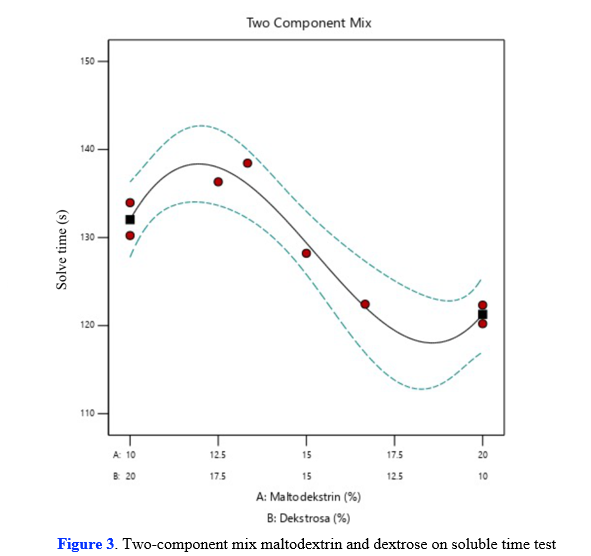
Onchidiid slug (Onchidium typhae) is an animal with bioactive compounds with high nutritional value and the potential to be used as a functional food product. The study aimed to optimize the onchidiid slug instant powder formula, analyze its proximate content, and determine its hedonic level. The formula of instant powder was made with a comparison of the composition of maltodextrin and dextrose based on the run in the D-Optimal Mixture Design (DMD) program, namely run 1 (20%:10%), run 2 (10%:20%), run 3 (13.33%: 16.67%), run 4 (16.67%:13.33%), run 5 (15%:15%), run 6 (12.5%:17.5%), run 7 (10%: 20%), run 8 (20%:10%). The powder is tested for water content and dissolution time, and the optimal formula is analyzed using One Sample T-Test in SPSS. The results showed that the composition of maltodextrin and dextrose significantly affected the characteristics of instant powder. The optimal instant powder formula combines 18.690% maltodextrin and 11.310% dextrose with a water content of 4.892% and a soluble time of 118.052 seconds. The results of statistical analysis in verifying the optimal formula show a p-value > 0.05 (not significant). The results of the proximate content test were 8.21% water content, 0.42% ash content, 0.85% crude fiber, 3.54% protein, and 1.54%. They had a preference level in the like and acceptable in terms of color, taste, texture, and scent.
References
Adhayanti, I., & Ahmad, T. (2021). Pengaruh Metode Pengeringan Terhadap Karakter Mutu Fisik dan Kimia Serbuk Minuman Instan Kulit Buah Naga. Media Farmasi, 16(1), 57. https://doi.org/10.32382/mf.v16i1.1418
Apandi, I., & Restuhadi, F. (2016). Analisis Pemetaan Kesukaan Konsumen (Consumer’s Preference Mapping) Terhadap Atribut Sensori Produk Soygurt Dikalangan Mahasiswa Fakultas Pertanian Universitas Riau. 3(1).
Budiyanto, A. K. (2015). Dasar-Dasar Ilmu Gizi. UMM Press.
Corie, Z. C., Koesoemawardan, D., Nurainy, F., & Nawansih, O. (2023). Penambahan Maltodektrin pada Minuman Serbuk Mangga dengan Metode Foam Mat Drying. Jurnal AGROHITA, 8(4), 695–703. http://dx.doi.org/10.31604/jap.v8i4.13593
Faulkner, D. J. (2002). Marine natural products. Natural Product Reports, 19(1), 1–49. https://doi.org/10.1039/B009029H
Hayes, M., & Mora, L. (2021). Alternative Proteins as a Source of Bioactive Peptides: The Edible Snail and Generation of Hydrolysates Containing Peptides with Bioactive Potential for Use as Functional Foods. Foods, 10(2), 276. https://doi.org/10.3390/foods10020276
Hui, Y. H. (1992). Encyclopedia of Food Science and Technology. Wiley. https://books.google.co.id/books?id=VrpTAAAAMAAJ
Husni, P., Fadhiilah, M. L., & Hasanah, U. (2020). Formulasi dan Uji Stabilitas Fisik Granul Instan Serbuk Kering Tangkai Genjer (limnocharis flava (l.) Buchenau.) sebagai Suplemen Penambah Serat. Jurnal Ilmiah Farmasi Farmasyifa, 3(1), 1–8. https://doi.org/10.29313/jiff.v3i1.5163
Kaljannah, A. R., Indriyani, I., & Ulyati, U. (2018). Pengaruh Konsentrasi Maltodekstrin Terhadap Sifat Fisik, Kimia, dan Organoleptik Minuman Serbuk Buah Mengkudu (Morinda Citrifolia L). Seminar Nasional Pembangunan Pertanian Berkelanjutan Berbasis Sumber Daya Lokal, 2019, 297–308.
Karthikeyan, A., Joseph, A., & Nair, B. G. (2022). Promising bioactive compounds from the marine environment and their potential effects on various diseases. Journal of Genetic Engineering and Biotechnology, 20(1), 14. https://doi.org/10.1186/s43141-021-00290-4
Lordan, S., Ross, R. P., & Stanton, C. (2011). Marine Bioactives as Functional Food Ingredients: Potential to Reduce the Incidence of Chronic Diseases. Marine Drugs, 9(6), 1056–1100. https://doi.org/10.3390/md9061056
Pringgenies, D. (2010). Karakteristik Senyawa Bioaktif Bakteri Simbion Moluska dengan GC-MS. Jurnal Ilmu Dan Teknologi Kelautan Tropis, 2(2), 34–40. http://dx.doi.org/10.28930/jitkt.v2i2.7850
Purbasari, D. (2019). Aplikasi Metode Foam-Mat Drying Dalam Pembuatan Bubuk Susu Kedelai Instan. Jurnal Agroteknologi, 13(1), 52–61. http://dx.doi.org/10.19184/j-agt.v13i01.9253
Putri, R. M. S., & Amrizal, S. N. (n.d.). Optimasi Formula Minuman Fungsional Serbuk Instan dari Brunok (Acaudina molpadioides) dengan metode pengeringan busa (Foam Mat Drying). Akuatikisle: Jurnal Akuakultur, Pesisir Dan Pulau-Pulau Kecil., 4(2), 73–78. https://doi.org/10.29239/j.akuatikisle.4.2.73-78
Rahmawati, A. Y., & Sutrisno, A. (2015). Hidrolisis Tepung Ubi Jalar Ungu (ipomea batatas l.) secara Enzimatis Menjadi Sirup Glukosa Fungsional: Kajian Pustaka. Jurnal Pangan dan Agroindustri, 3(3), 152–1159.
Usman, H. N., Pratiwi, L., & Wijianto, B. (2023). Cosmetic Serum Loaded Arabica Coffee (Coffea arabica) Extract: Formulation and Antioxidant Study. Traditional Medicine Journal, 8(2), 93–101. https://doi.org/10.22146/mot.83120
Utomo, D., & Ariska, S. B. (2020). Kualitas minuman serbuk instan sereh (Cymbopogon citratus) dengan metode foam mat drying. Teknologi Pangan : Media Informasi Dan Komunikasi Ilmiah Teknologi Pertanian, 11(1). https://doi.org/10.35891/tp.v11i1.1903
Wang, B., Chen, D., Yu, M., Liu, Y., Liu, P., & Zhang, X. (2021). A Review on Metabolites from Onchidium Genus: Chemistry and Bioactivity. Chemistry & Biodiversity, 18(2), e2000580. https://doi.org/10.1002/cbdv.202000580
Widyanti, E., Kusumawati, E., Sukmana, A. F., & Mudzakkir, Z. M. A. (2019). Penentuan tekanan dan waktu optimum dalam pembuatan serbuk telur menggunakan oven vakum. Fluida, 12(2), 50–57. https://doi.org/10.35313/fluida.v12i2.1601
Wijianto, B., Hamzah, H., Nurhidayah, A. L., Kemuning, G. I., & Dyas, R. A. A. (2022). Characterization of Onchidiid Slug (Onchidium typhae) West Kalimantan Waters as Antibacterials and Antifungal. Borneo Journal of Pharmacy, 5(1), 35–41. https://doi.org/10.33084/bjop.v5i1.2936
Wijianto, B., Nurhidayah, A. L., & Luliana, S. (2022). Standardization of secondary metabolites and heavy metal contamination assay on onchidiid slug (Onchidium typhae) West Kalimantan waters. Jurnal Farmasi Sains Dan Praktis, 8(3), 199–206. https://doi.org/10.31603/pharmacy.v8i3.7296