NANOEMULSION CHARACTERISTICS PREPARATIONS ETHANOL LEAF EXTRACTS IN VARIOUS PLANTS: LITERATURE REVIEW
DOI:
https://doi.org/10.31603/pharmacy.v8i3.4786Keywords:
Nanoemulsion, Ethanol extract, Leaf, CharacteristicsAbstract
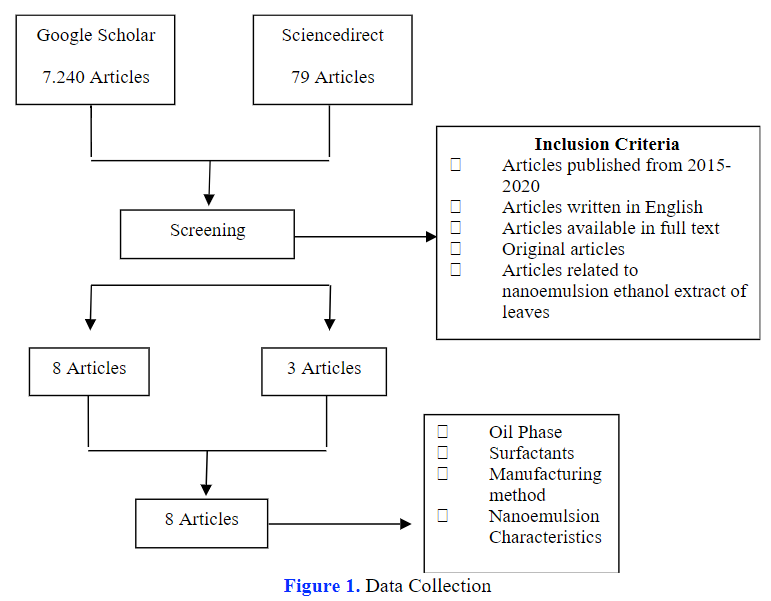
Nanoemulsion is one of the nanotechnology applications that can measure particles 0-100 nm which has control of the release of active ingredients and good sensory properties. Nanoemulsion of ethanol leaf extract in various plants has considerable potential in the utilization of natural materials. The solvent used is an important factor. This research focuses on plant leaf parts with ethanol extract. The purpose of this review is to study, evaluate and analyze literature focused on the characteristics of nanoemulsion preparations of ethanol leaf extracts in various plants related to nanoemulsion components, manufacturing methods, and nanoemulsion preparation characteristics. This research uses the method of literature review or narrative review, the search for published scientific literature is indexed in various databases. Search articles through various databases to ensure that the majority of relevant studies have been identified. Based on the results of the literature review concluded that the most widely used surfactant in the review of these articles is Polysorbat 80 or Tween 80 which is a non-ionic and non-irritative surfactant commonly used in pharmaceutical and cosmetic preparations. Ultrasonification and microfluidation methods are also applied in some articles because they are capable of producing a minimum droplet diameter of 150 to 170 nm..The results of the study of particle size in the article produced particle sizes between 10.9 nm-312.1 nm. Indeks polidispersitas value 0.08-0.7 zeta potential value above +/-30 and EE value shows value above 80%. It can be concluded that the nanoemulsion characteristics of each article meet the requirements and produce stable nanoemulsions.
References
Ahsan, A., Rezaul, M., & Shishir, I. (2016). Production, Stability And Application Of Micro And Nanoemulsion In Food Production And The Food Processing Industry. In Emulsions. Elsevier Inc. https://doi.org/10.1016/B978-0-12-804306-6/00012-X
Alvarado, H. L., Abrego, G., Souto, E. B., Garduño-Ramirez, M. L., Clares, B., GarcÃa, M. L., & Calpena, A. C. (2015). Nanoemulsions for dermal controlled release of oleanolic and ursolic acids: In vitro, ex vivo and in vivo characterization. Colloids and Surfaces B: Biointerfaces, 130, 40–47. https://doi.org/10.1016/j.colsurfb.2015.03.062
Arifianti, L., Oktarina, R. D., & Kusumawati, I. (2014). Pengaruh Jenis Pelarut Pengektraksi. E-Journal Planta Husada, 2(1), 3–6.
Atun, S., Arianingrum, R., Cahyaningsih, L., Pratiwi, F. A., Kusumaningrum, R., & Khairuddean, M. (2020). Formulation and characterization of quercitrin nanoemulsion isolated from dendropthoe falcata and its antioxidant activity test. Rasayan Journal of Chemistry, 13(3), 1347–1356. https://doi.org/10.31788/RJC.2020.1335868
Barreto, S. M. A. G., Maia, M. S., Benicá, A. M., de Assis, H. R. B. S., Leite-Silva, V. R., da Rocha-Filho, P. A., de Negreiros, M. M. F., de Oliveira Rocha, H. A., Ostrosky, E. A., Lopes, P. S., de Farias Sales, V. S., Giordani, R. B., & Ferrari, M. (2017). Evaluation of in vitro and in vivo safety of the by-product of Agave sisalana as a new cosmetic raw material: Development and clinical evaluation of a nanoemulsion to improve skin moisturizing. Industrial Crops and Products, 108, 470–479. https://doi.org/10.1016/j.indcrop.2017.06.064
Dewandari, K. T., Sofwan, G., & T, H. (2019). Preparasi Dan Karakterisasi Beads Kalsium Alginat Yang Mengandung Nanoemulsi Minyak Sawit Merah (Elaeis Guineensis Jacq.) Dengan Metode Gelasi Ionik. Jurnal Penelitian Pascapanen Pertanian, 15(2), 99. https://doi.org/10.21082/jpasca.v15n2.2018.99-105
Di Maio, G., Pittia, P., Mazzarino, L., Maraschin, M., & Kuhnen, S. (2019). Cow milk enriched with nanoencapsulated phenolic extract of jaboticaba (Plinia peruviana). Journal of Food Science and Technology, 56(3), 1165–1173. https://doi.org/10.1007/s13197-019-03579-y
El-Naggar, M. E., Hussein, J., El-sayed, S. M., Youssef, A. M., El Bana, M., Latif, Y. A., & Medhat, D. (2020). Protective effect of the functional yogurt based on Malva parviflora leaves extract nanoemulsion on acetic acid-induced ulcerative colitis in rats. Journal of Materials Research and Technology, 9(6), 14500–14508. https://doi.org/10.1016/j.jmrt.2020.10.047
Gadhave, A. D. (2014). Nanoemulsions: Formation, Stability and Applications. International Journal for Resear Ch in Science & Advanced Technologies Issue-3, 2(3), 38–43.
Hanifah, M., & Jufri, M. (2018). Formulation and stability testing of nanoemulsion lotion containing centella asiatica extract. Journal of Young Pharmacists, 10(4), 404–408. https://doi.org/10.5530/jyp.2018.10.89
Herbianto, A. S. (2018). Pengaruh Perbedaan Konsentrasi Surfaktan Terhadap Karakter Fisik Dan pH Nanoemulsi Pencerah Kulit. Calyptra: Jurnal Ilmiah Mahasiswa Universitas Surabaya, 7(1).
Hidayati, S. R. (2020). Formulasi Dan Uji Stabilitas Nanoemulsi Ekstrak Buah Parijoto (Medinilla speciosa Blume). Universitas Ngudi Waluyo. https://doi.org/10.1155/2010/706872
Hu, R., Hilakivi-Clarke, L., & Clarke, R. (2015). Molecular mechanisms of tamoxifen-associated endometrial cancer (Review). Oncology Letters, 9(4), 1495–1501. https://doi.org/10.3892/ol.2015.2962
Jaiswal, M., Dudhe, R., & Sharma, P. K. (2015). Nanoemulsion: an advanced mode of drug delivery system. 3 Biotech, 5, 123–127. https://doi.org/10.1007/s13205-014-0214-0
Jusnita, N., & Nasution, K. (2019). Formulasi Nanoemulsi Ekstrak Daun Kelor (Moringa oleifera Lamk). Industria: Jurnal Teknologi Dan Manajemen Agroindustri, 8(3), 165–170. https://doi.org/10.21776/ub.industria.2019.008.03.1
Jusnita, N., & Syurya, W. (2019). Karakteristik Nanoemulsi Ekstrak Daun Kelor (Moringa oleifera Lamk.). Jurnal Sains Farmasi & Klinis, 6(1), 16–24. https://doi.org/10.25077/jsfk.6.1.16-24.2019
Kamea, K. G. (2019). Formulasi Sediaan Gel Nanopartikel Lipid Ekstrak Tempe Terstandarisasi Genistein. In Universitas Sanata Dharma.
Khor, Y. P., Koh, S. P., Long, K., Long, S., Ahmad, S. Z. S., & Tan, C. P. (2014). A comparative study of the physicochemical properties of a virgin coconut oil emulsion and commercial food supplement emulsions. Molecules, 19(7), 9187–9202. https://doi.org/10.3390/molecules19079187
Koroleva, M. Y., & Yurtov, E. V. (2012). Nanoemulsions: the properties, methods of preparation and promising applications. Russian Chemical Reviews, 81(1), 21–43. https://doi.org/10.1070/rc2012v081n01abeh004219
Lee, S. J., & McClements, D. J. (2010). Fabrication of protein-stabilized nanoemulsions using a combined homogenization and amphiphilic solvent dissolution/evaporation approach. Food Hydrocolloids, 24, 560–569. https://doi.org/10.1016/j.foodhyd.2010.02.002
Limthin, D., & Phromyothin, D. (2017). Application of nanotechnology in Eichhornia crassipes extracts. Journal of Applied Science, 16(Special issue), 118–124. https://doi.org/10.14416/j.appsci.2017.10.s18
Listyorini, N. M. D., Wijayanti, N. L. P. D., & Astuti, K. W. (2018). Optimasi Pembuatan Nanoemulsi Virgin Coconut Oil. Jurnal Kimia, 8. https://doi.org/10.24843/jchem.2018.v12.i01.p02
Manasika, A., & Widjanarko, S. B. (2015). Carotenoid Pigment Extraction Of Kabocha Using Ultrasound Assisted Extraction (Study of Material: Solvent Ratio and Extraction Time). Jurnal Pangan Dan Agroindustri, 3(3), 928–938.
Mariadi, Prasetyo, B. E., Adela, H., & Wiladatika, W. (2019). Formulation and Characterization of Nanoemulsion of Tread leave Ethanol Extract (Catharanthus roseus (L.) G. Don) as Antihyperglycemic. Indonesian Journal of Pharmaceutical and Clinical Research, 2(2), 24–30. https://doi.org/10.32734/idjpcr.v2i2.3204
Mazzarino, L., da Silva Pitz, H., Lorenzen Voytena, A. P., Dias Trevisan, A. C., Ribeiro-Do-Valle, R. M., & Maraschin, M. (2018). Jaboticaba (Plinia peruviana) extract nanoemulsions: development, stability, and in vitro antioxidant activity. Drug Development and Industrial Pharmacy. https://doi.org/10.1080/03639045.2017.1405976
Modarres-Gheisari, S. M. M., Gavagsaz-Ghoachani, R., Malaki, M., Safarpour, P., & Zandi, M. (2018). Ultrasonic nano-emulsification – A review. Ultrasonics Sonochemistry, 52, 88–105. https://doi.org/10.1016/j.ultsonch.2018.11.005
Montes de Oca-Ãvalos, J. M., Candal, R. J., & Herrera, M. L. (2017). Nanoemulsions: stability and physical properties. Current Opinion in Food Science, 16, 1–19. https://doi.org/10.1016/j.cofs.2017.06.003
Pavoni, L., Perinelli, D. R., Bonacucina, G., Cespi, M., & Palmieri, G. F. (2020). An overview of micro-and nanoemulsions as vehicles for essential oils: Formulation, preparation and stability. Nanomaterials, 10(1). https://doi.org/10.3390/nano10010135
Poomanee, W., Khunkitti, W., Chaiyana, W., & Leelapornpisid, P. (2020). Optimization of mangifera indica L. Kernel extract-loaded nanoemulsions via response surface methodology, characterization, stability, and skin permeation for anti-acne cosmeceutical application. Pharmaceutics, 12, 1–16. https://doi.org/10.3390/pharmaceutics12050454
Rahmaniyah, D. N. K. (2018). Perbandingan formulasi nanoemulsi dan nanoemulsi gel hidrokortison dengan variasi konsentrasi fase minyak palm oil (Doctoral dissertation, Universitas Islam Negeri Maulana Malik Ibrahim).
Sarmah, S., Gogoi, S. B., Xianfeng, F., & Baruah, A. A. (2019). Characterization and identification of the most appropriate nonionic surfactant for enhanced oil recovery. Journal of Petroleum Exploration and Production Technology. https://doi.org/10.1007/s13202-019-0682-1
Sundararajan, B., Moola, A. K., Vivek, K., & Kumari, B. D. R. (2018). Formulation of nanoemulsion from leaves essential oil of Ocimum basilicum L. and its antibacterial, antioxidant and larvicidal activities (Culex quinquefasciatus). In Microbial Pathogenesis (Vol. 125). Elsevier Ltd. https://doi.org/10.1016/j.micpath.2018.10.017
Susanti, A. D., Ardiana, D., P.Gumelar, G., & G. Bening, Y. (2012). Polaritas Pelarut Sebagai Pertimbangan Dalam Pe,ilihan Pelarut Untuk Ekstraksi Minyak Bekatul Dari Bekatul Varietas Ketan (Oriza Sativa .G). Journal of Social Welfare and Family Law, 22(3), 277–294. https://doi.org/10.1080/01418030050130185
Suzetti, E. . (2017). Formulasi Dan Karakteristik Nanoemulsi Minyak Biji Kelor (Moringa oleifera) Dengan Surfaktan Dan Kosurfaktan. Skripsi, Universitas Setia Budi.
Swardini, Z. P. (2019). Optimasi Tween 80 Dan Lesitin Dalam Sediaan Nanoemulsion Ibuprofen.
Tsai, Y. J., & Chen, B. H. (2016). Preparation of catechin extracts and nanoemulsions from green tea leaf waste and their inhibition effect on prostate cancer cell PC-3. International Journal of Nanomedicine, 11, 1907–1926. https://doi.org/10.2147/IJN.S103759
Wang, D., Liu, C., Zhang, Z., Ye, L., Zhang, X., & Al, E. (2018). Testing a healthcare provider – patient communicative relationship quality model of pharmaceutical care in hospitals. International Journal of Clinical Pharmacy, 40(3), 617–626. https://doi.org/10.1007/s11096-018-0618-8
Yuliani, S. H., Hartini, M., Stephanie, Pudyastuti, B., & Istyastono, E. P. (2016). Perbandingan Stabilitas Fisis Sediaan Nanoemulsi Minyak Biji Delima Dengan Fase Minyak Long-Chain Triglyceride dan Medium Chain Triglyceride. Traditional Medicine Journal, 21(August), 3–7.
Yuliasari, S., Fardiaz, D., & Andarwulan, N. (2014). Karakteristik Nanoemulsi Minyak Sawit Merah Yang Diperkaya Beta Karoten Characteristics of Red Palm Oil Nanoemulsions Enriched with Beta Carotene. Littri, 20(September), 111–121.
Zaichik, S., Steinbring, C., Jelkmann, M., & Bernkop-Schnürch, A. (2020). Zeta potential changing nanoemulsions: Impact of PEG-corona on phosphate cleavage. International Journal of Pharmaceutics, 581(March), 119299. https://doi.org/10.1016/j.ijpharm.2020.119299
Zhang, S., Zhang, M., Fang, Z., & Liu, Y. (2016). Preparation and characterization of blended cloves/cinnamon essential oil nanoemulsions. LWT - Food Science and Technology. https://doi.org/10.1016/j.lwt.2016.08.046
Zorzi, G. K., Caregnato, F., Moreira, J. C. F., Teixeira, H. F., & Carvalho, E. L. S. (2016). Antioxidant Effect of Nanoemulsions Containing Extract of Achyrocline satureioides (Lam) D.C.—Asteraceae. AAPS PharmSciTech, 17(4), 844–850. https://doi.org/10.1208/s12249-015-0408-8