A LITERATURE REVIEW: THE POTENTIAL OF KARAMUNTING PLANT (Rhodomyrtus tomentosa) AS ANTIBACTERIAL AGENT
DOI:
https://doi.org/10.31603/pharmacy.v9i2.6415Keywords:
Karamunting, Rhodomyrtus tomentosa, Antibacterial, Literature ReviewAbstract
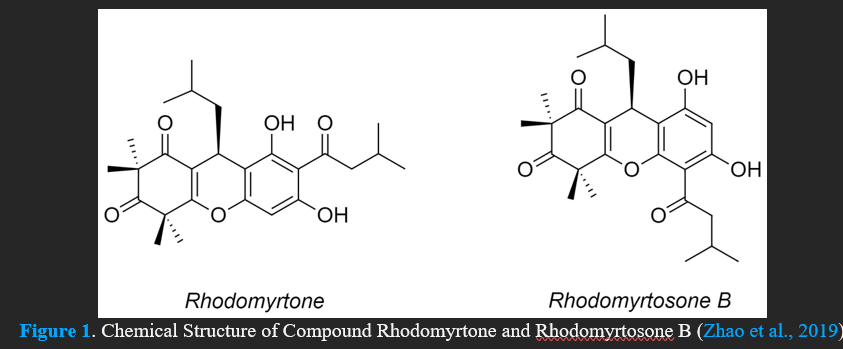
Infectious disease is a major health problem with a relatively high mortality rate. Indonesia is rich in natural ingredients that have potential as antibacterials, one of which is the Karamunting plant (Rhodomyrtus tomentosa). Several studies on this plant have been conducted to observe its activity as an antibacterial. This study aims to determine the antibacterial activity of Karamunting plants using the literature review method. The literature search method uses journals from the Google Scholar, Pub Med and Elsevier databases. Each journal is determined based on inclusion and exclusion criteria. Journals that meet the inclusion criteria are descriptive and explained in detail. From the journals obtained, there were 11 journals that met the criteria. Karamunting plants (Rhodomyrtus tomentosa) contain secondary metabolites namely flavonoids, glycosides, saponins, tannins, triterpenoids, steroids, acylphloroglucinol (rhodomyrtone, tomentosone, rhodomyrtosone) and meroterpenoids (rhotomentodiones). Antibacterial activity test using the diffusion method showed an optimum inhibition zone diameter of 21.5 mm against Staphylococcus aureus bacteria in the ethyl acetate fraction of Karamunting leaves with a concentration of 600 mg/ml, while using the microdilution method of ethanol extract of Karamunting leaves the minimum inhibition level was 0.5 µg/ml on Staphylococcus aureus bacteria. The leaves’ part presents the best antibacterial activity.
References
Dwicahmi, P. (2015). Uji Aktivitas Antibakteri Ekstrak Etanol 70% Daun Karamunting (Rhodomyrtus tomentosa (Ait.)Hassk) Terhadap Pertumbuhan Bakteri Vibrio cholerae Secara In Vitro. Jurnal Mahasiswa PSPD FK Universitas Tanjungpura, 3(1).
Institute for Health Metrics and Evaluation (IHME). (2018). Findings from the Global Burden of Disease Study 2017. IHME.
Joegijiantoro, R. (2019). Penyakit Infeksi. Intimedia.
Lan, T. T. Q., Khiem, V. M., & Van Tin, N. (2021). Antibacterial and Antioxidant Activity of Rhodomyrtus Tomentosa and Cinnamomum Zeylanicum Crude Extracts. Veterinary Science Research, 3(1). https://doi.org/10.30564/vsr.v3i1.2623
Liu, H., Li, P., Bi, L., Wu, W., Yan, H., He, L., Qin, X., & Liu, H. (2020). Polymethylated Phloroglucinol Meroterpenoids from Rhodomyrtus tomentosa and Their Antibacterial and Acetylcholinesterase Inhibitory Effects. Chemistry & Biodiversity, 17(10). https://doi.org/10.1002/cbdv.202000489
Liu, H.-X., Tan, H.-B., & Qiu, S.-X. (2016). Antimicrobial acylphloroglucinols from the leaves of Rhodomyrtus tomentosa. Journal of Asian Natural Products Research, 18(6), 535–541. https://doi.org/10.1080/10286020.2015.1121997
Na-Phatthalung, P., Chusri, S., Suanyuk, N., & Voravuthikunchai, S. P. (2017). In vitro and in vivo assessments of Rhodomyrtus tomentosa leaf extract as an alternative anti-streptococcal agent in Nile tilapia (Oreochromis niloticus L.). Journal of Medical Microbiology, 66(4), 430–439. https://doi.org/10.1099/jmm.0.000453
Rosli, M. F. A., Asaruddin, M. R., Romli, A. M., Radhakrishnan, S. E., & Ahmad, M. N. (2017). Phytochemical Studies of Rhodomyrtus tomentosa Leaves, Stem and Fruits as Antimicrobial and Antioxidant Agents. 6.
Salampe, M., Burhan, A., & Oktaviani, N. (2020). Skrining Antioksidan Dan Antikanker Ekstrak Etanol Daun Karamunting (Rhonomyrtus Tomentosa L.) Sebagai Obat Alternatif. 6.
Salim, Z., & Munadi, E. (2017). Info Komoditi Tanaman Obat. Badan Pengkajian dan Pengembangan Perdagangan Kementerian Perdagangan Republik Indonesia.
Saputra, H., Wibowo, M. A., & Rahmayanti, S. (2016). Uji Aktivitas Antibakteri Ekstrak Etanol Daun Karamunting (Rhodomyrtus tomentosa (Aiton) Hassk.) Terhadap Salmonella typhi Secara in Vitro. 16.
Shankar, S., Leejae, S., Jaiswal, L., & Voravuthikunchai, S. P. (2017). Metallic nanoparticles augmented the antibacterial potency of Rhodomyrtus tomentosa acetone extract against Escherichia coli. Microbial Pathogenesis, 107, 181–184. https://doi.org/10.1016/j.micpath.2017.03.036
Shou, Q., Smith, J. E., Mon, H., BrkljaÄa, Z., Smith, A.-S., Smith, D. M., Griesser, H. J., & Wohlmuth, H. (2014). Rhodomyrtals A–D, four unusual phloroglucinol-sesquiterpene adducts from Rhodomyrtus psidioides. RSC Adv., 4(26), 13514–13517. https://doi.org/10.1039/C4RA00154K
Sinaga, E., Rahayu, S. E., Suprihatin, & Yenisbar. (2019). Potensial Medisinal Karamungin (Rhodomyrtus tomentosa). UNAS Press.
Sinulingga, S. E., Hasibuan, P. A. Z., & Suryanto, D. (2018a). Antibacterial Activity of Karamunting (Rhodomyrtus Tomentosa (Aiton) Hassk) Leaf Extract and Fractions. Asian Journal of Pharmaceutical and Clinical Research, 11(3), 163. https://doi.org/10.22159/ajpcr.2018.v11i3.23505
Traithan, A., Tongtawe, P., Thanongsaksrikul, J., Voravuthikunchai, S., & Srimanote, P. (2020). Antibacterial mechanism of rhodomyrtone involves the disruption of nucleoid segregation checkpoint in Streptococcus suis. AMB Express, 10(1), 110. https://doi.org/10.1186/s13568-020-01047-x
World Health Organization. (2019). Leading causes of death and disability 2000-2019: A visual summary.
Yuliana, I., Asnawati, A., Ulfah, M., & Suhartono, E. (2021). Antidiabetic potential of karamunting leaves ethanolic extract as a natural herb: Blood glucose levels and pancreatic islets histomorphology on diabetic rat’s model. Jurnal Kedokteran Dan Kesehatan Indonesia. https://doi.org/10.20885/JKKI.Vol12.Iss3.art9
Zhao, L.-Y., Liu, H.-X., Wang, L., Xu, Z.-F., Tan, H.-B., & Qiu, S.-X. (2019). Rhodomyrtosone B, a membrane-targeting anti-MRSA natural acylgphloroglucinol from Rhodomyrtus tomentosa. Journal of Ethnopharmacology, 228, 50–57. https://doi.org/10.1016/j.jep.2018.09.011
Zulita, Rani, Aulia, M., & Nurhadini. (2018). Uji Aktivitas Antibakteri Ekstrak Daun Karamunting (Rhodomyrtus Tomentosa) Terhadap Bakteri Staphylococcus Aureus Dan Shigella Sp. Prosiding Seminar Nasional Penelitian & Pengabdian Pada Masyarakat, 2.