SOME NATURAL FLAVONOIDS FROM GUAVA (PSIDIUM GUAJAVA L.) AGAINST SARS COV-2, INSILICO PREDICTION AND DRUGS EVALUATION
DOI:
https://doi.org/10.31603/pharmacy.v8i2.6441Keywords:
Molecular docking, Chemical interaction, Flavonoid on Guava, ToxicityAbstract
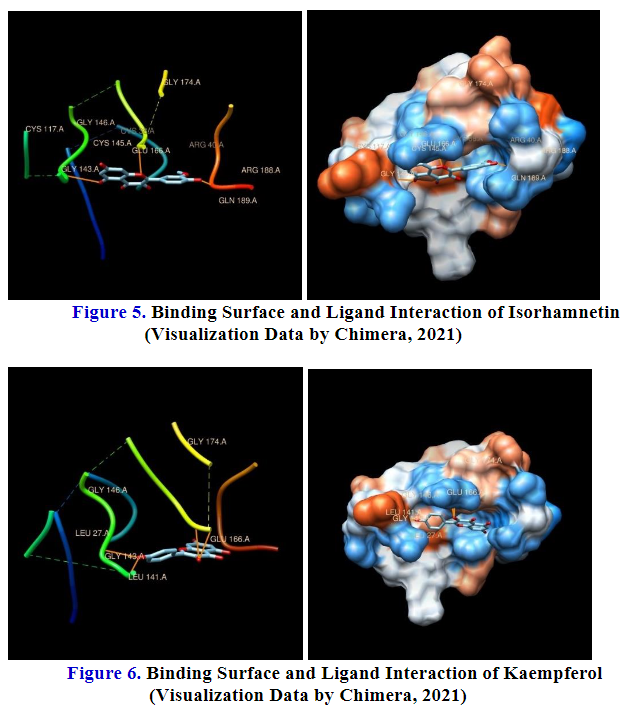
SARS-CoV-2 is a new virus that little is known about it, which has infected many people around the world. As COVID-19 cases continue to rise, it means more people are being infected, and there is still no targeted therapy for COVID-19 patients. Important for an emergency is to find the most potential Hesperidin, Kaempferol-3,4'-di-O-methyl ether (Ermanin); Myricetin-3-glucoside, Peonidine 3-(4’-arabinosylglucoside); Quercetin 3-(2G-rhamnosylrutinoside); and Rhamnetin 3-mannosyl-(1”“2)-alloside as a lead compound from guava to develop new drugs from flavonoid analogue. Docking method through iGEMDOCK software was used to design a new lead compound candidate from several flavonoid and study its interaction with of 3CLpro (PDB ID: 7DPU). The docking method were carried out using the iGEMDOCK software version v2.1, also in the chimera-1.13.1 program is used to know the interaction profile. Druglike properties were calculated using Lipinski’s rule of five as calculated using SWISSADME prediction. Toxicity prediction herein used ADMETSAR webserver (http://lmmd.ecust.edu.cn:8000/predict/). Less toxic and showing greater affinity with a docking score stronger was found in Quercetin, is apart from good pharmacokinetic profile.
References
Brochot, A., Guilbot, A., Haddioui, L., & Roques, C. (2017). Antibacterial, antifungal, and antiviral effects of three essential oil blends. Microbiology Open, 6(4), e00459. https://doi.org/10.1002/mbo3.459
Cheng, F., Li, W., Zhou, Y., Shen, J., Wu, Z., Liu, G., Lee, P. W., & Tang, Y. (2012). admetSAR: A Comprehensive Source and Free Tool for Assessment of Chemical ADMET Properties. Journal of Chemical Information and Modeling, 52(11), 3099–3105. https://doi.org/10.1021/ci300367a
Daina, A., Michielin, O., & Zoete, V. (2017). SwissADME: A free web tool to evaluate pharmacokinetics, drug-likeness and medicinal chemistry friendliness of small molecules. Scientific Reports, 7(1). https://doi.org/10.1038/srep42717
Erlina, L., Paramita, R. I., Kusuma, W. A., Fadilah, F., Tedjo, A., Pratomo, I. P., Ramadhanti, N. S., Nasution, A. K., Surado, F. K., & Fitriawan, A. (2020). Virtual screening on Indonesian herbal compounds as COVID-19 supportive therapy: Machine learning and pharmacophore modeling approaches.
Hamid Musa, K., Abdullah, A., & Subramaniam, V. (2015). Flavonoid profile and antioxidant activity of pink guava. ScienceAsia, 41(3), 149. https://doi.org/10.2306/scienceasia1513-1874.2015.41.149
Juergens, L. J., Worth, H., & Juergens, U. R. (2020). New Perspectives for Mucolytic, Anti-inflammatory and Adjunctive Therapy with 1,8-Cineole in COPD and Asthma: Review on the New Therapeutic Approach. Advances in Therapy, 37(5), 1737–1753. https://doi.org/10.1007/s12325-020-01279-0
Juergens, U. R., Dethlefsen, U., Steinkamp, G., Gillissen, A., Repges, R., & Vetter, H. (2003). Anti-inflammatory activity of 1.8-cineol (eucalyptol) in bronchial asthma: A double-blind placebo-controlled trial. Respiratory Medicine, 97(3), 250–256.
Kleine-Weber, H., Elzayat, M. T., Hoffmann, M., & Pöhlmann, S. (2018). Functional analysis of potential cleavage sites in the MERS-coronavirus spike protein. Scientific Reports, 8(1). https://doi.org/10.1038/s41598-018-34859-w
Kumar, D., Meena, M. K., Kumari, K., Patel, R., Jayaraj, A., & Singh, P. (2020). In-silico prediction of novel drug-target complex of nsp3 of CHIKV through molecular dynamic simulation. Heliyon, 6(8), e04720. https://doi.org/10.1016/j.heliyon.2020.e04720
Lau, K.-M., Lee, K.-M., Koon, C.-M., Cheung, C. S.-F., Lau, C.-P., Ho, H.-M., Lee, M. Y.-H., Au, S. W.-N., Cheng, C. H.-K., Lau, C. B.-S., Tsui, S. K.-W., Wan, D. C.-C., Waye, M. M.-Y., Wong, K.-B., Wong, C.-K., Lam, C. W.-K., Leung, P.-C., & Fung, K.-P. (2008). Immunomodulatory and anti-SARS activities of Houttuynia cordata. Journal of Ethnopharmacology, 118(1), 79–85. https://doi.org/10.1016/j.jep.2008.03.018
Lawson, M. A., Parrott, J. M., McCusker, R. H., Dantzer, R., Kelley, K. W., & O’Connor, J. C. (2013). Intracerebroventricular administration of lipopolysaccharide induces indoleamine-2, 3-dioxygenase-dependent depression-like behaviors. Journal of Neuroinflammation, 10(1), 1–9.
Peng, M., Watanabe, S., Chan, K. W. K., He, Q., Zhao, Y., Zhang, Z., Lai, X., Luo, D., Vasudevan, S. G., & Li, G. (2017). Luteolin restricts dengue virus replication through inhibition of the proprotein convertase furin. Antiviral Research, 143, 176–185. https://doi.org/10.1016/j.antiviral.2017.03.026
Pettersen, E. F., Goddard, T. D., Huang, C. C., Couch, G. S., Greenblatt, D. M., Meng, E. C., & Ferrin, T. E. (2004). UCSF Chimera?A visualization system for exploratory research and analysis. Journal of Computational Chemistry, 25(13), 1605–1612. https://doi.org/10.1002/jcc.20084
Sharma, A. D. (2020). Eucalyptol (1, 8 cineole) from eucalyptus essential oil a potential inhibitor of COVID 19 corona virus infection by molecular docking studies.
Siddik, Z. H. (2003). Cisplatin: Mode of cytotoxic action and molecular basis of resistance. Oncogene, 22(47), 7265–7279. https://doi.org/10.1038/sj.onc.1206933
Topçu, G., Şenol, H., Ali̇M Toraman, G. Ö., & Altan, V. M. (2020). Natural Alkaloids as Potential Anti-Coronavirus Compounds. Bezmialem Science, 8(3), 131–139. https://doi.org/10.14235/bas.galenos.2020.5035
Trujillo-Correa, A. I., Quintero-Gil, D. C., Diaz-Castillo, F., Quiñones, W., Robledo, S. M., & Martinez-Gutierrez, M. (2019). In vitro and in silico anti-dengue activity of compounds obtained from Psidium guajava through bioprospecting. BMC Complementary and Alternative Medicine, 19(1). https://doi.org/10.1186/s12906-019-2695-1
Wu, C., Liu, Y., Yang, Y., Zhang, P., Zhong, W., Wang, Y., Wang, Q., Xu, Y., Li, M., Li, X., Zheng, M., Chen, L., & Li, H. (2020). Analysis of therapeutic targets for SARS-CoV-2 and discovery of potential drugs by computational methods. Acta Pharmaceutica Sinica B, 10(5), 766–788. https://doi.org/10.1016/j.apsb.2020.02.008
Yang, C.-W., Lee, Y.-Z., Kang, I.-J., Barnard, D. L., Jan, J.-T., Lin, D., Huang, C.-W., Yeh, T.-K., Chao, Y.-S., & Lee, S.-J. (2010). Identification of phenanthroindolizines and phenanthroquinolizidines as novel potent anti-coronaviral agents for porcine enteropathogenic coronavirus transmissible gastroenteritis virus and human severe acute respiratory syndrome coronavirus. Antiviral Research, 88(2), 160–168. https://doi.org/10.1016/j.antiviral.2010.08.009
Yi, L., Li, Z., Yuan, K., Qu, X., Chen, J., Wang, G., Zhang, H., Luo, H., Zhu, L., Jiang, P., Chen, L., Shen, Y., Luo, M., Zuo, G., Hu, J., Duan, D., Nie, Y., Shi, X., Wang, W., Xu, X. (2004). Small Molecules Blocking the Entry of Severe Acute Respiratory Syndrome Coronavirus into Host Cells. Journal of Virology, 78(20), 11334–11339. https://doi.org/10.1128/JVI.78.20.11334-11339.2004