USE OF ANTICOAGULANT IN COVID-19 PATIENTS AT PKU MUHAMMADIYAH GAMPING HOSPITAL YOGYAKARTA
DOI:
https://doi.org/10.31603/pharmacy.v9i2.7038Keywords:
Covid-19, Anticoagulant, Heparin, Clinical improvement, APTTAbstract
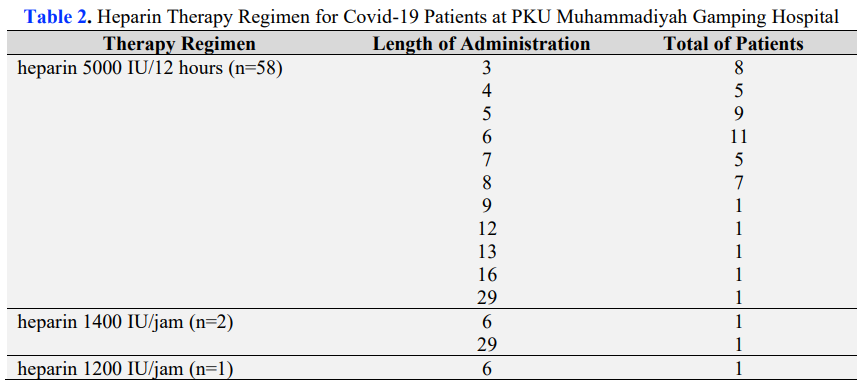
Based on WHO data, there is about 14% average of patients who suffer from a severe level of Covid-19 disease and 5% of patients admitted to the ICU (Intensive Care Unit) are known to have symptoms of thromboembolism and coagulopathy disorders. The current management of Covid-19 therapy requires heparin. This research aims to find out the accuracy of the heparin regimen, to determine the improvement of the patient's clinical condition, the side effects of heparin based on clinical response, to analyze the relationship between the accuracy of the therapeutic regimen and the improvement of the patient's clinical condition, and also to know the incidence of side effects after heparin use. The type of this research was descriptive-analytic with a cohort design with retrospective data collection. The data were collected by taking medical records at PKU Muhammadiyah Gamping Hospital Yogyakarta. Moreover, the data were collected including heparin therapy regimens with subjective condition and patient objective during the therapy. The data obtained were analyzed by using univariate analysis technique and bivariate analysis technique. The results showed there were 61 patients who fulfilled the inclusion criteria. The evaluation of the accuracy the heparin therapy regimen obtained 95.08% correct results and 4.92% incorrect results. The analysis result of the accuracy the therapeutic regimen showed a significant relationship with clinical improvement with parameters APTT number (p=0.006; RR=0.155; CI = 0.085-0.283). Whereas, there was not found a significant relationship between the accuracy of the therapeutic regimen with the incidence of side effects (p>0.05).
References
Aronson, J. (2000). Handbook Meyler’s side effects of drugs edisi 15 (The Encyclopedia of Adverse Drug Reactions and Interactions. In Handbook Meyler’s side effects of drugs edisi 15 (The Encyclopedia of Adverse Drug Reactions and Interactions.
Barnes, G. D., Burnett, A., Allen, A., Blumenstein, M., Clark, N. P., Cuker, A., Dager, W. E., Deitelzweig, S. B., Ellsworth, S., Garcia, D., Kaatz, S., & Minichiello, T. (2020). Thromboembolism and anticoagulant therapy during the COVID-19 pandemic: interim clinical guidance from the anticoagulation forum. Journal of Thrombosis and Thrombolysis, 50(1), 72–81. https://doi.org/10.1007/s11239-020-02138-z
Bruminhent, J., Ruangsubvilai, N., Nabhindhakara, J., Ingsathit, A., & Kiertiburanakul, S. (2020). Clinical characteristics and risk factors for coronavirus disease 2019 (COVID-19) among patients under investigation in Thailand. PLoS ONE, 15(9 September), 1–14. https://doi.org/10.1371/journal.pone.0239250
Burhan, E. (2020). Protokol Tatalaksana Covid-19. 1, 1–50.
Cuker, A., Tseng, E. K., Nieuwlaat, R., Angchaisuksiri, P., Blair, C., Dane, K., Davila, J., DeSancho, M. T., Diuguid, D., Griffin, D. O., Kahn, S. R., Klok, F. A., Lee, A. I., Neumann, I., Pai, A., Pai, M., Righini, M., Sanfilippo, K. M., Siegal, D., … Schünemann, H. J. (2021). American Society of Hematology 2021 guidelines on the use of anticoagulation for thromboprophylaxis in patients with COVID-19. Blood Advances, 5(3), 872–888. https://doi.org/10.1182/bloodadvances.2020003763
Farghaly, S., & Makboul, M. (2021). Correlation between age, sex, and severity of Coronavirus disease-19 based on chest computed tomography severity scoring system. Egyptian Journal of Radiology and Nuclear Medicine, 52(1), 1–8. https://doi.org/10.1186/s43055-021-00408-1
JPW, H. (2020). COVID-19: COVID-19 and risk factors for hospital admission, severe disease and death [Covid-19 og risikofaktorer for sykehusinnleggelse, alvorlig sykdom og død - en hurtigoversikt, tredje oppdatering. Hurtigoversikt 2020] Oslo: Norwegian Institute of Publ. Health (San Francisco), 9637–9637.
Kemenkes RI. (2020). Peta Sebaran COVID-19. In Gugus Tugas Percepatan Penanganan COVID-19 (pp. 3–4).
Levi, M., Thachil, J., Iba, T., & Levy, J. H. (2020). Coagulation abnormalities and thrombosis in patients with COVID-19. The Lancet Haematology, 7(6), e438–e440. https://doi.org/10.1016/S2352-3026(20)30145-9
Liu, Z., Li, J., Huang, J., Guo, L., Gao, R., Luo, K., Zeng, G., Zhang, T., Yi, M., Huang, Y., Chen, J., Yang, Y., & Wu, X. (2020). Association Between Diabetes and COVID-19: A Retrospective Observational Study With a Large Sample of 1,880 Cases in Leishenshan Hospital, Wuhan. Frontiers in Endocrinology, 11(July), 1–7. https://doi.org/10.3389/fendo.2020.00478
Long, H., Nie, L., Xiang, X., Li, H., Zhang, X., Fu, X., Ren, H., Liu, W., Wang, Q., & Wu, Q. (2020). D-Dimer and Prothrombin Time Are the Significant Indicators of Severe COVID-19 and Poor Prognosis. BioMed Research International, 2020. https://doi.org/10.1155/2020/6159720
Miesbach, W., & Makris, M. (2020). COVID-19: Coagulopathy, Risk of Thrombosis, and the Rationale for Anticoagulation. Clinical and Applied Thrombosis/Hemostasis, 26. https://doi.org/10.1177/1076029620938149
Musoke, N., Lo, K. B., Albano, J., Peterson, E., Bhargav, R., Gul, F., & Rangaswami, J. (2020). Anticoagulation and bleeding risk in patients with COVID-19. Thrombosis research, 196, 227-230.
Parohan, M., Yaghoubi, S., Seraji, A., Javanbakht, M. H., Sarraf, P., & Djalali, M. (2021). Risk factors for mortality in patients with Coronavirus disease 2019 (COVID-19) infection: a systematic review and meta-analysis of observational studies. The Aging Male, 23(5), 1416–1424. https://doi.org/10.1080/13685538.2020.1774748
Rusdiana, T., & Akbar, R. (2020). Perkembangan Terkini Terapi Antikoagulan Pada Pasien Covid-19 Bergejala Berat. Jurnal Sains Farmasi & Klinis, 7(3), 248. https://doi.org/10.25077/jsfk.7.3.248-254.2020
Spyropoulos, A. C. (2020). The management of venous thromboembolism in hospitalized patients with COVID-19. Blood Advances, 4(16), 4028–4028. https://doi.org/10.1182/bloodadvances.2020002496
Susilo, A. (2021). Coronavirus Disease 2019: Tinjauan Literatur Terkini. Tim Penanganan Kasus Pasien Dengan Penyakit Infeksi New Emerging Dan Re-Emerging Disease (PINERE) RSUPN Dr. Cipto Mangunkusumo, Jakarta 2 Departemen Ilmu Penyakit Dalam Fakultas Kedokteran Universitas Indonesia - RSUPN Dr. Cipto Mangunkusumo, Jakarta, 22(2), 97–110. https://doi.org/10.25104/transla.v22i2.1682
Tang, N., Bai, H., Chen, X., Gong, J., Li, D., & Sun, Z. (2020). Anticoagulant treatment is associated with decreased mortality in severe coronavirus disease 2019 patients with coagulopathy. Journal of thrombosis and haemostasis, 18(5), 1094-1099.
WHO. (2021). Cnical management Clinical management: Living guidance COVID-19. World Health Organization, Jalinuary.