STANDARDIZATION OF SECONDARY METABOLITES AND HEAVY METAL CONTAMINATION ASSAY ON ONCHIDIID SLUG (ONCHIDIUM TYPHAE) WEST KALIMANTAN WATERS
DOI:
https://doi.org/10.31603/pharmacy.v8i3.7296Keywords:
Heavy Metal Contamination Assay, Standardization of Secondary Metabolites, Onchidiid slug, Onchidium typhaeAbstract
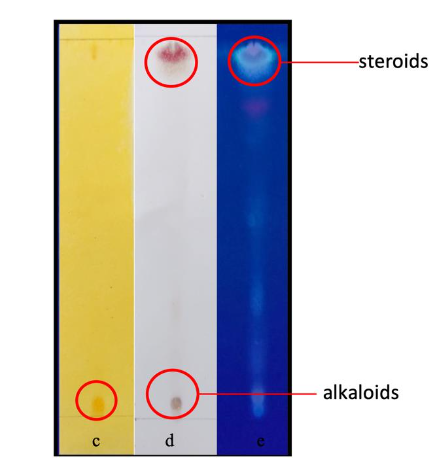
Onchidiid slug or Onchidium typhae is a marine animal commonly found in West Kalimantan waters. This gastropod is commonly used as medicine and cosmetic by the locals. This research aims to assure the content and quality of O. typhae methanol extract by determining its secondary metabolites and heavy metal contamination. Phytochemical screening of alkaloid, steroid/ triterpenoid, flavonoid, tannin, and saponin are done using reagent tests. Chromatography profile was completed using silica gel G60 F254 plate and hexane: ethyl acetate: methanol as mobile phase. Heavy metal contamination analysis was performed using atomic absorption spectrophotometry to determine Hg, As, Cd, and Pb content. The phytochemical screening and chromatography profile of O. typhae methanol extract confirm the presence of alkaloids and steroids. Heavy metal analysis stated Hg, As, Cd, and Pb content in O. typhae are < 0,0008; < 0,001; < 0,001; and 0,05 ppm respectively. Since heavy metal levels are below the maximum contamination limit, it qualifies as a natural product ingredient.
References
AOAC. (2016). Guidelines for Standard Method Performance Requirements. Journal of AOAC International and Office Methode of Analysis, 1–18.
Asgari Lajayer, B., Ghorbanpour, M., & Nikabadi, S. (2017). Heavy metals in contaminated environment: Destiny of secondary metabolite biosynthesis, oxidative status and phytoextraction in medicinal plants. Ecotoxicology and Environmental Safety, 145, 377–390. https://doi.org/10.1016/j.ecoenv.2017.07.035
Badan Standardisasi Nasional. (2005). SNI 06-6989.54-2005 Cara uji kadar arsen (As) dengan spektrofotometer serapan atom secara tungku karbon. Badan Standardisasi Nasional.
Badan Standardisasi Nasional. (2019a). SNI 6989.78:2019 Cara uji raksa (Hg) secara spektrofotometri serapan atom uap dingin atau Mercury Analyzer. Badan Standardisasi Nasional.
Badan Standardisasi Nasional. (2019b). SNI 6989.84:2019 Cara uji kadar logam terlarut dan logam total secara spektrofotometri serapan atom nyala. Badan Standardisasi Nasional.
Bambang Wijianto, Hasyrul Hamzah, Annisa Larasati Nurhidayah, Guci Intan Kemuning, & Riyadh Aqilsya Amaryl Dyas. (2022). Characterization of Onchidiid Slug (Onchidium typhae) West Kalimantan Waters as Antibacterials and Antifungal TI2—Borneo Journal of Pharmacy. https://doi.org/10.33084/bjop.v5i1.2936
Fernández, R., RodrÃguez, J., Quiñoá, E., Riguera, R., Muñoz, L., Fernández-Suárez, M., & Debitus, C. (1996). Onchidin B: A New Cyclodepsipeptide from the Mollusc Onchidium sp. Journal of the American Chemical Society, 118(46), 11635–11643. https://doi.org/10.1021/ja961314i
Fontana, A., Cavaliere, P., Wahidulla, S., Naik, C. G., & Cimino, G. (2000). A New Antitumor Isoquinoline Alkaloid from the Marine Nudibranch Jorunna funebris. Tetrahedron, 56(37), 7305–7308. https://doi.org/10.1016/S0040-4020(00)00629-3
Gamal, mohammed gamal. (2020). Development of a Green Stability-Indicating HPLC-DAD Method For The Analysis of Tildipirosin in Pharmaceutical Formulation. Acta Poloniae Pharmaceutica - Drug Research, 77(3), 443–452. https://doi.org/10.32383/appdr/122147
Guan, J., Shen, H. D., Qian, J., Zhang, K. X., & Zheng, P. (2013). Analysis and evaluation of nutritive composition of four species of Onchidiidae. Sci. Tech. Food Industry, 349–354.
Harborne, J. B. (1984). Metode Fitokimia: Penuntun Cara Modern Menganalisis Tumbuhan. ITB Bandung.
Harmawan, T., & Lestari, D. (2020). Pemeriksaan logam berat cadmium (Cd) dan plumbum (Pb) pada lipstik yang beredar di Pasar Brayan Medan Timur secara spektrofotometri serapan atom (SSA). Quimica: Jurnal Kimia Sains Dan Terapan, 2(2), 18–22.
Harmono, H. (2020). Validasi Metode Analisis Logam Merkuri (Hg) Terlarutn pada Air Permukaan dengan Automatic Mercury Analyzer. Indonesian Journal of Laboratory, 2, 11. https://doi.org/10.22146/ijl.v2i3.57047
Karnakar, N., Hechhu, R., Amani, P., Tharun, S., Nagaraju, M., & Sharma, S. (2020). Analytical method development and validation of diclofenac sodium by UV-visible spectroscopy using AUC method. The Journal of Rehabilitation Research and Development, Volume 7;, 20–24.
Li, C., Zhou, K., Qin, W., Tian, C., Qi, M., Yan, X., & Han, W. (2019). A Review on Heavy Metals Contamination in Soil: Effects, Sources, and Remediation Techniques. Soil and Sediment Contamination: An International Journal, 28(4), 380–394. https://doi.org/10.1080/15320383.2019.1592108
Li, Q., Cai, S., Mo, C., Chu, B., Peng, L., & Yang, F. (2010). Toxic effects of heavy metals and their accumulation in vegetables grown in a saline soil. Ecotoxicology and Environmental Safety, 73(1), 84–88. https://doi.org/10.1016/j.ecoenv.2009.09.002
Meharg, A. (2011). Trace Elements in Soils and Plants. 4th edition. By A. Kabata-Pendias. Boca Raton, FL, USA: CRC Press/Taylor & Francis Group (2010), pp. 548, US$159.95. ISBN 9781420093681. Experimental Agriculture, 47, 739. https://doi.org/10.1017/S0014479711000743
Naser, H. A. (2013). Assessment and management of heavy metal pollution in the marine environment of the Arabian Gulf: A review. Marine Pollution Bulletin, 72(1), 6–13. https://doi.org/10.1016/j.marpolbul.2013.04.030
Prayoga, G., Hariyadi, S., Sulistiono, S., & Effendi, H. (2021). Heavy metal (Pb, Hg, Cu) contamination level in sediment and water in Segara Anakan Lagoon, Cilacap, Indonesia. IOP Conference Series: Earth and Environmental Science, 744, 012055. https://doi.org/10.1088/1755-1315/744/1/012055
Shahid, M., Dumat, C., Khalid, S., Schreck, E., Xiong, T., & Niazi, N. K. (2017). Foliar heavy metal uptake, toxicity and detoxification in plants: A comparison of foliar and root metal uptake. Journal of Hazardous Materials, 325, 36–58. https://doi.org/10.1016/j.jhazmat.2016.11.063
Shahid, M., Khalid, S., Abbas, G., Shahid, N., Nadeem, M., Sabir, M., Aslam, M., & Dumat, C. (2015). Heavy Metal Stress and Crop Productivity. In K. R. Hakeem (Ed.), Crop Production and Global Environmental Issues (pp. 1–25). Springer International Publishing. https://doi.org/10.1007/978-3-319-23162-4_1
Singh Sankhla, M., Kumari, M., Nandan, M., Kumar, R., & Agrawal, P. (2016). Heavy Metals Contamination in Water and their Hazardous Effect on Human Health-A Review. International Journal of Current Microbiology and Applied Sciences, 5, 759–766. https://doi.org/10.20546/ijcmas.2016.510.082
Tchounwou, P. B., Yedjou, C. G., Patlolla, A. K., & Sutton, D. J. (2012). Heavy Metal Toxicity and the Environment. In A. Luch (Ed.), Molecular, Clinical and Environmental Toxicology (Vol. 101, pp. 133–164). Springer Basel. https://doi.org/10.1007/978-3-7643-8340-4_6
Vogel, S. G. (1990). Buku teks analisis anorganik kualitatif makro dan semimikro. Kalman Media Pustaka.
Wagner, H., & Bladt, S. (1996). Plant Drug Analysis (2nd ed., Vol. 15). Springer Berlin. https://doi.org/10.1007/978-3-642-00574-9
Wang, B., Chen, D., Yu, M., Liu, Y., Liu, P., & Zhang, X. (2021). A Review on Metabolites from Onchidium Genus: Chemistry and Bioactivity. Chemistry & Biodiversity, 18(2). https://doi.org/10.1002/cbdv.202000580
Yi, Y., Yang, Z., & Zhang, S. (2011). Ecological risk assessment of heavy metals in sediment and human health risk assessment of heavy metals in fishes in the middle and lower reaches of the Yangtze River basin. Nitrogen
Deposition, Critical Loads and Biodiversity, 159(10), 2575–2585. https://doi.org/10.1016/j.envpol.2011.06.011
Zhou, Z.-F., Li, X.-L., Yao, L.-G., Li, J., Gavagnin, M., & Guo, Y.-W. (2018). Marine bis-γ-pyrone polypropionates of onchidione family and their effects on the XBP1 gene expression. Bioorganic & Medicinal Chemistry Letters, 28(6), 1093–1096. https://doi.org/10.1016/j.bmcl.2018.02.010