ANALGETIC POWER OF ETHANOL EXTRACT BROTOWALI (TINOSPORA CORDIFOLIA) IN SWISS MICE
DOI:
https://doi.org/10.31603/pharmacy.v8i3.7909Keywords:
Brotowali, Analgesic, Acetic acid, FlavonoidsAbstract
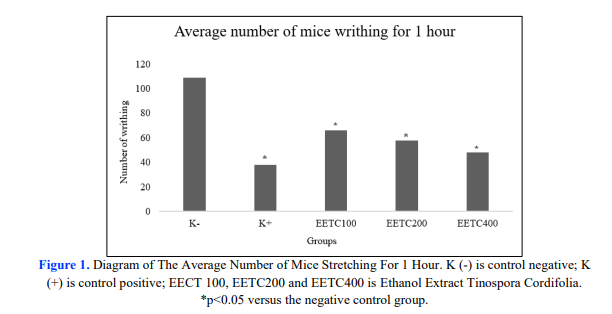
Brotowali (Tinospora cordifolia) plants are usually used for various kinds of treatment it is often used as a febrifuge, brotowali stems are proven to contain flavonoid compounds that have benefits in the treatment of various diseases, one of which is analgesic. This purpose is to determine the effectiveness of analgesics on male Swiss mice induced by acetic acid from the ethanol extract of brotowali stem (EETC) doses of 100 mg/Kg BW, 200 mg/Kg BW, and 400 mg/Kg BW. Brotowali stem extraction using maceration method with 70% ethanol solvent. EETC was tested by phytochemical screening and TLC to determine the content of active compounds. The test animals used Swiss male mice, the treatment group was divided into 5, negative control group, positive control, and the dose groups were 100 mg/kg BW, 200 mg/kg BW, and 400 mg/kg BW. Testing is done by the writhing test method. Induction of pain stimuli using acetic acid, the number of mice writhing every 10 minutes for 1 hour, and the percentage of analgesic power. Research shows the yield of EETC is 16.35%. The percentage of analgetic power of dose I was 39%, dose II was 47% and dose III was 56% less than the percentage of analgesic power of methampyrone dose of 65 mg/KgBB which was 64%. Conclusion EETC doses of 100 mg/kg BW, 200 mg/kg BW, and 400 mg/kg BW have analgesic activity equivalent to methampyrone at a dose of 65 mg/kg BW, with the largest percentage of analgesic protection at a dose of 400 mg/Kg BW of 56%.
References
Adedapo, A. A., Aremu, O. J., & Oyagbemi, A. A. (2014). Anti-Oxidant, anti-inflammatory and antinociceptive properties of the acetone leaf extract of Vernonia Amygdalina in some laboratory animals. Advanced Pharmaceutical Bulletin, 4(Suppl 2), 591–598. https://doi.org/10.5681/apb.2014.087
Firmansyah, D., Mulyani, A., & Dwitiyani, D. (2019). Aktivitas Analgetika Ekstrak Etanol Daun Sukun (Artocapus altilis) Terhadap Mencit Putih Jantan Yang Diinduksi Asam Asetat Analgetic Activities Of Breadfruit (Artocarpus altilis) Ethanol Extract To White Male Mice Induced By Acetic Acid. Medical Sains, 4(1), 13–18.
Goel, B., Pathak, N., Nim, D. K., Singh, S. K., Dixit, R. K., & Chaurasia, R. (2014). Clinical evaluation of analgesic activity of Guduchi (Tinospora Cordifolia) using animal model. Journal of Clinical and Diagnostic Research, 8(8), 1–4. https://doi.org/10.7860/JCDR/2014/9207.4671
Hijazi, M. A., El-Mallah, A., Aboul-Ela, M., & Ellakany, A. (2017). Evaluation of Analgesic Activity of Papaver libanoticum Extract in Mice: Involvement of Opioids Receptors. Evidence-Based Complementary and Alternative Medicine, 2017. https://doi.org/10.1155/2017/8935085
Hossain, M. M., Hasan, S. M. R., Akter, R., Islam, M. N., Rashid, M. J., Saha, M. R., Hoque, M. E., & Mazumder, S. R. (2009). Stamford Journal of Pharmaceutical Sciences Evaluation of analgesic and neuropharmacological properties of the aerial part ofTinospora cordifolia Miers. in mice. S.J.Pharm, 31–37.
Hussain, L., Akash, M. S. H., Ain, N. U., Rehman, K., & Ibrahim, M. (2015). The analgesic, anti-inflammatory and anti-pyretic activities of Tinospora cordifolia. Advances in Clinical and Experimental Medicine, 24(6), 957–964. https://doi.org/10.17219/acem/27909
Jo, H. G., Lee, G. Y., Baek, C. Y., Song, H. S., & Lee, D. (2021). Analgesic and anti-inflammatory effects of aucklandia lappa root extracts on acetic acid-induced writhing in mice and monosodium iodoacetate-induced osteoarthritis in rats. Plants, 10(1), 1–13. https://doi.org/10.3390/plants10010042
Khan, M. M., Haque, M. S., & Chowdhury, M. S. I. (2017). Medicinal use of the unique plant Tinospora Cordifolia: evidence from the traditional medicine and recent research. Asian Journal of Medical and Biological Research, 2(4), 508–512. https://doi.org/10.3329/ajmbr.v2i4.30989
Kiromah, N. Z. W., Miyarso, C., & Krisdiyanti, Y. (2021). Analgesic Activities of Ethanolic and Methanolic Extract of Ganitri Leaves (Elaeocarpus ganitrus Roxb): In vivo study. Journal of Fundamental and Applied Pharmaceutical Science, 2(1), 53–58. https://doi.org/10.18196/jfaps.v2i1.12159
Mandal, P., Das, A. K., Mandal, A., & Biswas, T. K. (2020). A study to evaluate efficacy of Tinospora cordifolia (Guduchi) as analgesic agent using albino wistar rats as an experimental animal model. International Journal of Basic & Clinical Pharmacology, 9(2), 242. https://doi.org/10.18203/2319-2003.ijbcp20200170
Pawar, H., Karde, M., Mundle, N., And, P. J., & Mehra, K. (2014). Phytochemical Evaluation and Curcumin Content Determination of Turmeric Rhizomes Collected From Bhandara District of Maharashtra (India). Medicinal Chemistry, 4(8), 588–591. https://doi.org/10.4172/2161-0444.1000198
Prayitno, S., & Ahung, M. S. (2020). Uji Efek Analgetik Fraksinasi Ekstrak Etanol Batang Brotowali (Tinospora Crispa L.) Terhadap Mencit (Mus Musculus) Analgesic Test of Fractionation of Ethanol Extract of Brotowali Stems (Tinospora Crispa L.) Against Mice (Mus Musculus). Fito Medicine : Journal Pharmacy and Sciences ISSN, 12, 1.
Rukshana, M.S., Doss, A. and Kumari, P. R. (2017). Phytochemical Screening and GC-MS Analysis of Leaf Extract of Pergularia daemia (Forssk) Chiov. Pelagia Research Library Asian Journal of Plant Science and Research, 7(1), 9–15.
Salim, E., Fatimah, C., & Fanny, D. Y. (2017). Analgetic Activity Of Cep-Cepan (Saurauia cauliflora DC.) Leaves Extract. Jurnal Natural, 17(1), 31. https://doi.org/10.24815/jn.v17i1.6856
Sharma, A., & Kaur, G. (2018). Tinospora cordifolia as a potential neuroregenerative candidate against glutamate induced excitotoxicity: An in vitro perspective 11 Medical and Health Sciences 1109 Neurosciences. BMC Complementary and Alternative Medicine, 18(1), 1–17. https://doi.org/10.1186/s12906-018-2330-6
Sharma, P., Dwivedee, B. P., Bisht, D., Dash, A. K., & Kumar, D. (2019). The chemical constituents and diverse pharmacological importance of Tinospora cordifolia. Heliyon, 5(9), e02437. https://doi.org/10.1016/j.heliyon.2019.e02437
Singh, B., Nathawat, S., & Sharma, R. A. (2021). Ethnopharmacological and phytochemical attributes of Indian Tinospora species: A comprehensive review. Arabian Journal of Chemistry, 14(10), 103381. https://doi.org/10.1016/j.arabjc.2021.103381
Sumanlata, Suman, A., Sharma, R. K., Jindal, M., & Khan, A. (2019). Evaluation of the analgesic activity of the water soluble extract of stem of Tinospora cordifolia in experimentally induced pain in albino rats. International Journal of Research in Medical Sciences, 7(3), 938. https://doi.org/10.18203/2320-6012.ijrms20190953
Syamsul, E. S., Andani, F., & Soemarie, Y. B. (2016). Analgesic Activity Study Of Ethanolic Extract Of Callicarpa longifolia Lamk. IN MICE. Majalah Obat Tradisional, 21(2), 99–103.
Warsinah, Baroroh, H. N., & Harwoko. (2020). Phytochemical analysis and antioxidant activity of brotowali (Tinospora crispa l. mier) stem. Molekul, 15(2), 73–78. https://doi.org/10.20884/1.jm.2020.15.2.533
Winarti, L., & Wantiyah. (2011). Uji Efek Analgetika Ekstrak Rimpang Temu Kunci (Boesenbergia pandurata ( Roxb .) Schlechter Pada Mencit Jantan Galur Swiss Examination Of Analgetics Effect Of Extract Boesenbergia Pandurata ( Roxb .) Schlechter To Swiss Furrow Male Mice. Majalah Obat Tradisional, 16(1), 26–33.