MOLECULAR DOCKING STUDIES OF FLAVONOIDS FROM SECANG WOOD (Caesalpinia sappan L.) AGAINST GLUCOKINASE ENZYME AS ANTIDIABETIC CANDIDATES
DOI:
https://doi.org/10.31603/pharmacy.v10i2.8228Keywords:
Diabetes mellitus, Caesalpinia sappan, Glucokinase, Molecular docking, FlavonoidAbstract
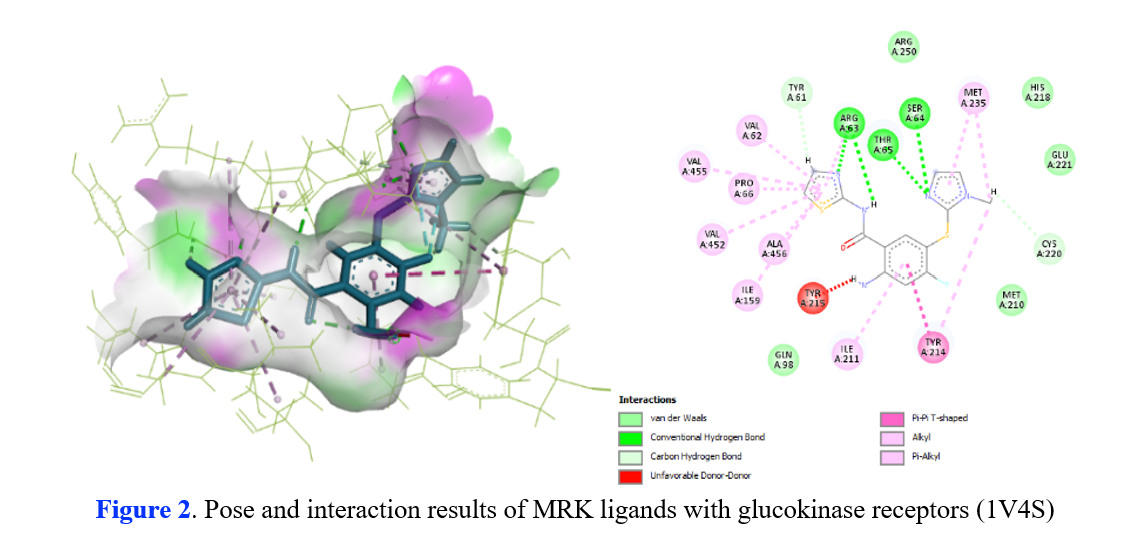
Diabetes mellitus (DM) is a metabolic disease caused by a deficiency of insulin secretion, insulin resistance, and increased hepatic glucose production. Secang wood (Caesalpinia sappan L.) is known to have antihyperglycemic activity. However, these compounds are not yet known. In silico studies are needed to determine the compounds that act as antidiabetics. This study performed molecular docking of flavonoid compounds in sappan wood against the 1V4S glucokinase receptor. The results showed that all flavonoid compounds of sappan wood were predicted to have antidiabetic activity because they had a lower docking score than metformin, the first-line therapy of type 2 diabetes mellitus. Butein is expected to have the best activity. It has the lowest docking score (-94.4836). Visualization of the docking results shows that butein interacts with the identical amino acid residues as metformin, namely ARG 63 and THR 65, through the formation of hydrogen bonds and Van der Waals interactions. SWISS-ADME web tool predicted that butein has good oral absorption and excretion. The toxicity prediction tool showed a slight contradiction in the mutagenic effect. Based on this research, molecular docking may be able to design new drugs, especially from butein in sappan wood (Caesalpinia sappan L.), as antidiabetic candidates.
References
Adelina, R. (2020). Simulasi Docking Molekuler Senyawa Potensial Tanaman Justicia Gendarussa Burm.f. Sebagai Antidiabetes. Buletin Penelitian Kesehatan, 48(2), 117–122. https://doi.org/10.22435/bpk.v48i2.3139
Adriani. (2018). Prediksi Senyawa Bioaktif dari Tanaman Sanrego (Lunasia amara Blanco) sebagai Inhibitor Enzim Siklooksigenase-2 (COX-2) melalui Pendekatan Molecular Docking. Jurnal Ilmiah Pena, Sains Dan Ilmu Pendidikan, 1(1), 6–11.
Al-Ishaq, R. K., Abotaleb, M., Kubatka, P., Kajo, K., & Büsselberg, D. (2019). Flavonoids and their anti-diabetic effects: Cellular mechanisms and effects to improve blood sugar levels. Biomolecules, 9(9). https://doi.org/10.3390/biom9090430
Al Mogren, M. M., Zerroug, E., Belaidi, S., BenAmor, A., & Al Harbi, S. D. A. (2020). Molecular structure, drug likeness and QSAR modeling of 1,2-diazole derivatives as inhibitors of enoyl-acyl carrier protein reductase. Journal of King Saud University - Science, 32(4), 2301–2310. https://doi.org/10.1016/j.jksus.2020.03.007
Arsiningtyas, I. S. (2015). Search for α-glucosidase inhibitors from Indonesian indigenous plants [Hokkaido University]. https://doi.org/10.14943/doctoral.k12000
Arwansyah., Ambarsari, L., Sumaryada, T. I. (2014). Simulasi Docking Senyawa Kurkumin dan Analognya Sebagai Inhibitor Reseptor Androgen pada Kanker Prostat. Current Biochemistry, 1(1), 11–19. https://doi.org/10.29244/cb.1.1.11-19
Astuty, F., Komari, N. (2022). Kajian Molecular Docking Senyawa Karwinaphthol B dari Tanaman Bawang Dayak (Eleutherine palmifolia ( L .) Merr) sebagai Inhibitor Enzim Glukokinase. Jurnal Natural Scientiae, 2(1), 1–9. https://doi.org/10.20527/jns.v2i1.5412
Chen, X., Li, H., Tian, L., Li, Q., Luo, J., & Zhang, Y. (2020). Analysis of the Physicochemical Properties of Acaricides Based on Lipinski’s Rule of Five. Journal of Computational Biology, 27(9), 1397–1406. https://doi.org/10.1089/cmb.2019.0323
Daina, A., Michielin, O., & Zoete, V. (2017). SwissADME: A free web tool to evaluate pharmacokinetics, drug-likeness and medicinal chemistry friendliness of small molecules. Scientific Reports, 7(42717), 1–13. https://doi.org/10.1038/srep42717
Ibrahim, Z. Y., Uzairu, A., Shallangwa, G. A., & Abechi, S. E. (2021). Pharmacokinetic predictions and docking studies of substituted aryl amine-based triazolopyrimidine designed inhibitors of Plasmodium falciparum dihydroorotate dehydrogenase (PfDHODH). Future Journal of Pharmaceutical Sciences, 7(1). https://doi.org/10.1186/s43094-021-00288-2
IDF. (2019). IDF Diabetes Atlas. International Diabetes Federation.
Khan, A., Unnisa, A., Sohel, M., Date, M., Panpaliya, N., Saboo, S. G., Siddiqui, F., & Khan, S. (2022). Investigation of phytoconstituents of Enicostemma littorale as potential glucokinase activators through molecular docking for the treatment of type 2 diabetes mellitus. In Silico Pharmacology, 10(1). https://doi.org/10.1007/s40203-021-00116-8
Kilo, L.A., Aman, L.O., Sabihi, I., Kilo, J. L. (2019). Studi Potensi Pirazolin Tersubstitusi 1-N Dari Tiosemikarbazon Sebagai Agen Antiamuba Melalui Uji In Silico. Indo. J. Chem, 7(1), 9–16. https://doi.org/10.30598/ijcr.2019.7-akr.
Mahendran, G., Manoj, M., Murugesh, E., Kumar, R. S., Shanmughavel, P., Prasad, K. J. R., & Bai, V. N. (2014). In vivo anti-diabetic, antioxidant and molecular docking studies of 1, 2, 8-trihydroxy-6-methoxy xanthone and 1, 2-dihydroxy-6-methoxyxanthone-8-O-β- d-xylopyranosyl isolated from Swertia corymbosa. Phytomedicine, 21(11), 1237–1248. https://doi.org/10.1016/j.phymed.2014.06.011
Nirmal, N. P., Rajput, M. S., Prasad, R. G. S. V., & Ahmad, M. (2015). Brazilin from Caesalpinia sappan heartwood and its pharmacological activities: A review. Asian Pacific Journal of Tropical Medicine, 8(6), 421–430. https://doi.org/10.1016/j.apjtm.2015.05.014
Nitami, S. F., Febriansah, R. (2019). Penambatan Molekular Senyawa Tangeretin dan Kampferol pada Protein Antiapoptosis Bcl-xL: Studi In Silico. Acta Pharmaciae Indonesia, 7(2), 42–50. https://doi.org/10.5281/zenodo.3707059
Ononamadu, C. J., & Ibrahim, A. (2021). Molecular docking and prediction of ADME/drug-likeness properties of potentially active antidiabetic compounds isolated from aqueous-methanol extracts of Gymnema sylvestre and Combretum micranthum. Biotechnologia: Journal of Biotechnology, Computational Biology and Bionanotechnology, 102(1), 85–99. https://doi.org/10.5114/bta.2021.103765
Putri, P. V. P., Susanti, N. M. P., Laksmiani, N. P. L. (2019). Senyawa Kuersetin Sebagai Agen Antikanker Kolorektal Secara in Silico. Jurnal Kimia, 13(2), 166–171. https://doi.org/10.24843/jchem.2019.v13.i02.p07
Rachmania, R. A., Supandi., Larasati, O. A. (2015). Analisis In-Silico Senyawa Diterpenoid Lakton Herba Sambiloto (Andrographis paniculata Nees) Pada Reseptor Alpha-Glucosidase Sebagai Antidiabetes Tipe 2. Pharmacy, 12(2), 210–222.
Rajalakshmi, R., Lalitha, P., Sharma, S. C., Rajiv, A., Chithambharan, A., & Ponnusamy, A. (2021). In silico studies: Physicochemical properties, drug score, toxicity predictions and molecular docking of organosulphur compounds against Diabetes mellitus. Journal of Molecular Recognition, 34(11), 1–16. https://doi.org/10.1002/jmr.2925
Ram, H., Kala, C., Sen, K., Sakarwal, A., Charan, J., Sharma, P., Roy, R., & Ghosh, S. (2022). In-vitro and in-silico determinations of HMG-CoA reductase inhibition potential of caffeic acid for therapeutics of hypercholesterolemia. Journal of Applied Pharmaceutical Science, 12(1), 190–198. https://doi.org/10.7324/JAPS.2021.120119
Sa’pang, M. (2015). Efek Antihiperglikemik Minuman Secang (Caesalpinia Sappan Linn.) Pada Wanita Dewasa Dengan Pradiabetes. 9–11.
Sari, I. W., Junaidin., Pratiwi, D. (2020). Studi Molecular Docking Senyawa Flavonoid Herba Kumis Kucing (Orthosiphon stamineus B.) Pada Reseptor Α-Glukosidase Sebagai Antidiabetes Tipe 2. Jurnal Farmagazine, 7(2), 54–60. https://doi.org/10.47653/farm.v7i2.194
Setiawan, H. Irawan, M. I. (2017). Kajian Pendekatan Penempatan Ligan Pada Protein Menggunakan Algoritma Genetika. Jurnal Sains Dan Seni ITS, 6(2), 2–6. https://doi.org/10.12962/j23373520.v6i2.25468
Shweta, M., & Rashmi, D. (2019). In-vitro ADME studies of TUG-891, a GPR-120 inhibitor using Swiss ADME predictor. Journal of Drug Delivery & Therapeutics, 9(2-s), 266–369. https://doi.org/10.22270/jddt.v9i2-s.2710.
Soelistijo, Soebagijo Adi., Lindarto, Dharma., Decroli, Eva., Permana, Hikmat., Sucipto, Krishna W., Kusnadi, Yulianto., Budiman., Ikhsan, M Robikhul., Sasiarini, Laksmi., Sanusi, H. (2019). Pengelolaan Dan Pencegahan Diabetes Melitus Tipe 2 Dewasa di Indonesia. Perkumpulan Endokrinologi Indonesia, 133.
Yusuf, M., Wati, A. (2019). Efek Infus Kayu Secang (Caesalpinia sappan L.) Terhadap Penurunan Kadar Gula Darah Mencit (Mus musculus). Media Farmasi, 15(1). https://doi.org/10.32382/mf.v15i1.807.