EVALUATION OF KNOWLEDGE AND BEHAVIOR ON ANALGESIC SELF-MEDICATION IN HEALTH AND NON-HEALTH STUDENTS AT MUHAMMADIYAH UNIVERSITY, YOGYAKARTA
DOI:
https://doi.org/10.31603/pharmacy.v10i1.8828Keywords:
Knowledge, Behavior, Analgesic self-medication, Health student, Non-health studentAbstract
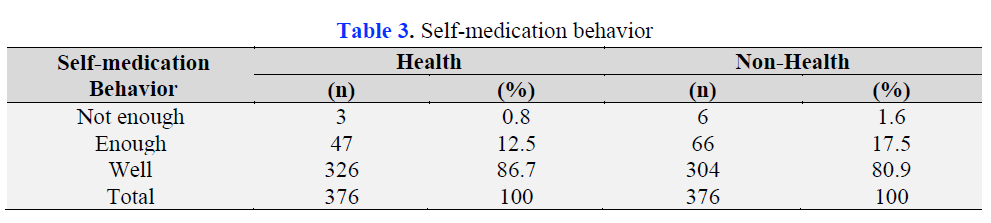
Pain is the most common cause that encourages someone to do self-medication. A person's level of knowledge is known to influence a person's behavior in self-medication. The study evaluates the level of knowledge and behavior toward self-medication using analgesics among health and non-health students at the University of Muhammadiyah Yogyakarta. This research uses a non-experimental observational research design with a cross-sectional approach. The sample used was 752 health and non-health students at the University of Muhammadiyah Yogyakarta. The level of knowledge of health students is good, with a percentage of 75.3% good; 21.0% is sufficient; and 3.7% is less, while the level of knowledge of non-health students is adequate, with a percentage of 33.5% good; 50.5% is sufficient; and 16.0% is less. The behavior of health students is good, with 86.7% good, 12.5% adequate, and 0.8% less, while the behavior of non-health students is good, with 80.9% good, 17.5% enough, and 1.6% less. The difference in the level of knowledge and behavior of analgesic self-medication between health and non-health students is quite significant, with the results of the Mann-Whitney test analysis showing a value of 0.000 on the level of knowledge and 0.001 on behavior. The relationship between the level of knowledge and behavior of health students and the Spearman Rank correlation test showed a result of 0.039 with an R-value of 0.107. In contrast, non-health students showed a result of 0.027 with an R-value of 0.114, indicating a significant and weak relationship between both.
References
Aljadhey, H., Alhusan, A., Alburikan, K., Adam, M., Murray, M. D., & Bates, D. W. (2013). Medication safety practices in hospitals: A national survey in Saudi Arabia. Saudi Pharmaceutical Journal, 21(2), 159–164. https://doi.org/10.1016/j.jsps.2012.07.005
Apsari, D. P., Jaya, M. K. A., Wintariani, N. P., & Suryaningsih, N. P. A. (2020). Pengetahuan, sikap dan praktik swamedikasi pada mahasiswa universitas bali internasional. Jurnal Ilmiah Medicamento, 6(1), 53–58. https://doi.org/10.36733/medicamento.v6i1.780
Arrais, P. S. D., Fernandes, M. E. P., Pizzol, T. D. S. D., Ramos, L. R., Mengue, S. S., Luiza, V. L., Tavares, N. U. L., Farias, M. R., Oliveira, M. A., & Bertoldi, A. D. (2016). Prevalence of self-medication in Brazil and associated factors. Revista de Saúde Pública, 50(suppl 2). https://doi.org/10.1590/s1518-8787.2016050006117
Arundina, A., & Widyaningrum, K. (2020). Numbers and Potential Causes of Medication Error in Inpatient Service of Rumah Sakit Islam Malang. Jurnal Kedokteran Brawijaya, 31(2), 127–130. https://doi.org/10.21776/ub.jkb.2020.031.02.11
Badan Pusat Statistik, R. I. (2019). Survei Sosial Ekonomi Nasional (SUSENAS) Kor, 2019.pdf.
Chautrakarn, S., Khumros, W., & Phutrakool, P. (2021). Self-Medication With Over-the-counter Medicines Among the Working Age Population in Metropolitan Areas of Thailand. Frontiers in Pharmacology, 12. https://www.frontiersin.org/articles/10.3389/fphar.2021.726643
De Sanctis, V., Soliman, A. T., Daar, S., Di Maio, S., Elalaily, R., Fiscina, B., & Kattamis, C. (2020). Prevalence, attitude and practice of self-medication among adolescents and the paradigm of dysmenorrhea self-care management in different countries. Acta Bio Medica Atenei Parmensis, 91(1), 182–192. https://doi.org/10.23750/abm.v91i1.9242
Eissa, A. T. (2013). Knowledge, Attitudes and Practices towards Medication Use among Health Care Students in King Saud University. International Journal of Medical Students, 1(2), Article 2. https://doi.org/10.5195/ijms.2013.205
Faqihi, A. H. M. A., & Sayed, S. F. (2021). Self-medication practice with analgesics (NSAIDs and acetaminophen), and antibiotics among nursing undergraduates in University College Farasan Campus, Jazan University, KSA. Annales Pharmaceutiques Françaises, 79(3), 275–285. https://doi.org/10.1016/j.pharma.2020.10.012
Gupta, S., & Chakraborty, A. (2022). Pattern and practice of self medication among adults in an urban community of West Bengal. Journal of Family Medicine and Primary Care, 11(5), 1858. https://doi.org/10.4103/jfmpc.jfmpc_1823_20
Harahap, N. A., Khairunnisa, K., & Tanuwijaya, J. (2017). Patient knowledge and rationality of self-medication in three pharmacies of Panyabungan City, Indonesia. Jurnal Sains Farmasi & Klinis, 3(2), 186. https://doi.org/10.29208/jsfk.2017.3.2.124
Irawati, R., Rumi, A., & Parumpu, F. A. (2021). Gambaran Tingkat Pengetahuan Swamedikasi Obat Analgesik Pada Mahasiswa-Mahasiswi Universitas Tadulako Di Kota Palu. Jurnal Health Sains, 2(3), Article 3. https://doi.org/10.46799/jhs.v2i3.107
Nursalam, N. (2020). Metodologi Penelitian Keperawatan Praktis (5th ed.). Salemba Medika.
Paut Kusturica, M., Tomas, A., & Sabo, A. (2016). Disposal of Unused Drugs: Knowledge and Behavior Among People Around the World. In P. de Voogt (Ed.), Reviews of Environmental Contamination and Toxicology Volume 240 (Vol. 240, pp. 71–104). Springer International Publishing. https://doi.org/10.1007/398_2016_3
Perkasa, A. K. G. Y., Sugihantoro, H., & Syahrir, A. (2020). Hubungan tingkat pengetahuan terhadap perilaku swamedikasi maag pada mahasiswa universitas islam negeri maulana malik ibrahim malang di ma’had tahun ajaran 2019/2020. Central of Library Universitas Islam Negeri Maulana Malik Ibrahim Malang. http://etheses.uin-malang.ac.id/21144/1/16670034.pdf
Serge, P., Jacques, C., Pascal, L., bertrand, Q., C, R., Jean-Yves, M., Herve, B., & Alain, B. (2019). Self-medication in pain management: The state of the art of pharmacists’ role for optimal Over-The-Counter analgesic use. European Journal of Pain (London, England), 23(10). https://doi.org/10.1002/ejp.1459
WHO guidelines for the regulatory assessment of medicinal products for use in self-medication: General information. (2000). WHO Drug Information 2000 ; 14(1) : 18-26. https://apps.who.int/iris/handle/10665/57624
Winarno, M. E. (2018). Buku Metodologi Penelitian dalam Pendidikan Jasmani, Penerbit Universitas Negri Malang (UM Press), cetakan ketiga, ISBN :979.495.673.2