POTENTIAL KETAPANG (Terminalia cattapa) LEAF EXTRACT AS A DOXORUBICIN CO-CHEMOTHERAPY AGENT ON BREAST (T47D) AND CERVIX (HeLa) CANCER CELL LINES
DOI:
https://doi.org/10.31603/pharmacy.v10i1.9845Keywords:
Terminalia cattapa, Cytotoxicity, Doxorubicin, T47D, HeLaAbstract
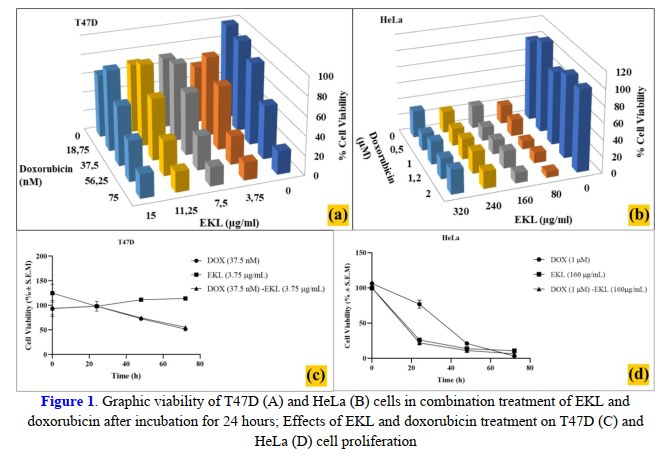
Doxorubicin (DOX) is chemotherapy for breast and cervical cancer with serious side effects. Ketapang (Terminalia cattapa) is a potential plant as a co-chemotherapy agent. The purpose of this research was to examine the sensitivity of DOX as a cytotoxicity drug in combination with ethanolic extracts of ketapang leaves (EKL) against T47D and HeLa cancer cells. Cytotoxicity was determined using the MTT assay, with DOX concentration series (0.625-40 nM for T47D and 0.5-6 M for HeLa) and EKL (50-1000 mg/mL) used in combination with the study. DOX and EKL combination assays utilizing their respective IC50 values were performed in T47D cells and HeLa cells, and the results were used to calculate the Combination Index (CI). Furthermore, the doubling time method was used to investigate the combination of DOX and EKL proliferation inhibition on both cell lines. DOX and EKL had IC50 values of 158 nM and 30 mg/mL for T47D, respectively, and 3.4 M and 640 mg/mL for HeLa cell growth. While DOX and EKL have a synergistic effect on T47D cells, their combined effect on HeLa cells is cytotoxic and dose-dependent. EKL increases the inhibitory effect of DOX on the proliferation of T47D and HeLa cancer cells. In T47D cells, the combination of DOX and EKL has a higher potential for cytotoxic and antiproliferative activity than in HeLa cells
References
Altun, İ., & Sonkaya, A. (2018). The Most Common Side Effects Experienced by Patients Were Receiving First Cycle of Chemotherapy. Iranian Journal of Public Health, 47(8), 1218–1219.
Artanti, A. N., Pujiastuti, U. H., Prihapsara, F., & Rakhmawati, R. (2020). Synergistic Cytotoxicity Effect by Combination of Methanol Extract of Parijoto Fruit (Medinilla speciosa Reinw. Ex. Bl) and Cisplatin Against Hela Cell Line. Indonesian Journal of Cancer Chemoprevention, 11(1), Article 1. https://doi.org/10.14499/indonesianjcanchemoprev11iss1pp16-21
Bouris, P., Skandalis, S. S., Piperigkou, Z., Afratis, N., Karamanou, K., Aletras, A. J., Moustakas, A., Theocharis, A. D., & Karamanos, N. K. (2015). Estrogen receptor alpha mediates epithelial to mesenchymal transition, expression of specific matrix effectors and functional properties of breast cancer cells. Matrix Biology, 43, 42–60. https://doi.org/10.1016/j.matbio.2015.02.008
Braciuliene, A., Janulis, V., & Petrikaite, V. (2022). The Chemo-Sensitizing Effect of Doxorubicin of Apple Extract-Enriched Triterpenic Complex on Human Colon Adenocarcinoma and Human Glioblastoma Cell Lines. Pharmaceutics, 14(12), 2593. https://doi.org/10.3390/pharmaceutics14122593
Bukowski, K., Kciuk, M., & Kontek, R. (2020). Mechanisms of Multidrug Resistance in Cancer Chemotherapy. International Journal of Molecular Sciences, 21(9), 3233. https://doi.org/10.3390/ijms21093233
CCRC. (2013). Protocol.
Chen, P. S., Li, J. H., Liu, T. Y., & Lin, T. C. (2000). Folk medicine Terminalia catappa and its major tannin component, punicalagin, are effective against bleomycin-induced genotoxicity in Chinese hamster ovary cells. Cancer Letters, 152(2), 115–122. https://doi.org/10.1016/S0304-3835(99)00395-X
Chu, S. C., Yang, S. F., Liu, S. J., Kuo, W. H., Chang, Y. Z., & Hsieh, Y. S. (2007). In vitro and in vivo antimetastatic effects of Terminalia catappa L. leaves on lung cancer cells. Food and Chemical Toxicology, 45(7), 1194–1201. https://doi.org/10.1016/j.fct.2006.12.028
Ghasemi, M., Turnbull, T., Sebastian, S., & Kempson, I. (2021). The MTT Assay: Utility, Limitations, Pitfalls, and Interpretation in Bulk and Single-Cell Analysis. International Journal of Molecular Sciences, 22(23), 12827. https://doi.org/10.3390/ijms222312827
Hanahan, D. (2022). Hallmarks of Cancer: New Dimensions. Cancer Discovery, 12(1), 31–46. https://doi.org/10.1158/2159-8290.CD-21-1059
Ho, J.-Y., Chang, F.-W., Huang, F. S., Liu, J.-M., Liu, Y.-P., Chen, S.-P., Liu, Y.-L., Cheng, K.-C., Yu, C.-P., & Hsu, R.-J. (2016). Estrogen Enhances the Cell Viability and Motility of Breast Cancer Cells through the ERα-ΔNp63-Integrin β4 Signaling Pathway. PloS One, 11(2), e0148301. https://doi.org/10.1371/journal.pone.0148301
Kusuma, A. W., Nurulita, N. A., & Hartanti, D. (2010). Cytotoxic And Antiproliferative Effects Of Quersetin In Widr Colon Cancer Cells. Pharmacy, 7(3), 107–122.
Lour, G., & Meiyanto, E. (2007). Suppression of DMBA-induced carcinogenesis of breast cancer in post initition stage by ethanolic extract of Gynura procumbens (Lour), Merr leaves. Majalah Farmasi Indonesia, 18(4), 169–175.
Mahdavi, M., Azadbakht, M., Vahdati, A., Shokrzadeh, M., & Farhadi, A. (2019). Cytotoxic effects of juglone and Pterocarya fraxinifolia on prostate cancer cells. Journal of Pharmacy And Bioallied Sciences, 11(3), 195. https://doi.org/10.4103/jpbs.JPBS_203_18
Mayer, E. L., & Burstein, H. J. (2007). Chemotherapy for Metastatic Breast Cancer. Hematology/Oncology Clinics of North America, 21(2), 257–272. https://doi.org/10.1016/j.hoc.2007.03.001
Morioka, T., Suzui, M., Nabandith, V., Inamine, M., Aniya, Y., Nakayama, T., Ichiba, T., & Yoshimi, N. (2005). Modifying effects of Terminalia catappa on azoxymethane-induced colon carcinogenesis in male F344 rats. European Journal of Cancer Prevention : The Official Journal of the European Cancer Prevention Organisation (ECP), 14(2), 101–105.
Pamplona-Silva, M. T., Mazzeo, D. E. C., Bianchi, J., & Marin-Morales, M. A. (2018). Estrogenic Compounds: Chemical Characteristics, Detection Methods, Biological and Environmental Effects. Water, Air, & Soil Pollution, 229(5), 144. https://doi.org/10.1007/s11270-018-3796-z
Reynolds, C. P., & Maurer, B. J. (2005). Evaluating Response to Antineoplastic Drug Combinations in Tissue Culture Models. In Chemosensitivity (Vol. 110, pp. 173–184). Humana Press. https://doi.org/10.1385/1-59259-869-2:173
Sahala, A., & Soegihardjo, C. J. (2012). Uji aktivitas antioksidan dan penetapan kadar fenolat total fraksi air daun ketapang (. Farmasi Sains Dan Komunitas, 9(2), 91–97.
Saroja, M., Santhi, R., & Annapoorani. (2012). Studies on immunomodulatory activity of flavonoid fractions of Terminalia cattapa in Swiss albino mice. Int J Pharm Biosci., 3(2), 418–422.
Shah, M. A., & Schwartz, G. K. (2001). Cell Cycle-Mediated Drug Resistance: An Emerging Concept in Cancer Therapy. Clinical Cancer Research: An Official Journal of the American Association for Cancer Research, 7(8), 2168–2181.
Siegel, R. L., Miller, K. D., & Jemal, A. (2019). Cancer statistics, 2019 (US statistics). CA: A Cancer Journal for Clinicians, 69(1), 7–34. https://doi.org/10.3322/caac.21551
Thorn, C. F., Oshiro, C., Marsh, S., Hernandez-Boussard, T., McLeod, H., Klein, T. E., & Altman, R. B. (2011). Doxorubicin pathways: Pharmacodynamics and adverse effects. Pharmacogenetics and Genomics, 21(7), 440–446. https://doi.org/10.1097/FPC.0b013e32833ffb56
Venkatalakshmi, P., Vadivel, V., & Brindha, P. (2016). Phytopharmacological Significance of Terminalia Catappa L.: An Updated Review. International Journal of Research in Ayurveda & Pharmacy, 7(2), 130–137. https://doi.org/10.7897/2277-4343.07272
Yunas, S. R., Latifah, N., Rohman, M. R., Fitriasari, A., & Meiyanti, E. (2013). Ethanolic extract of mandarin orange (Citrus reticulata) peels to increase the sensitivity of breast cancer cell to doxorubicin. Journal of Chemical Information and Modeling, 53(9), 1689–1699. https://doi.org/10.1017/CBO9781107415324.004
Zhou, H.-M., Zhang, J.-G., Zhang, X., & Li, Q. (2021). Targeting cancer stem cells for reversing therapy resistance: Mechanism, signaling, and prospective agents. Signal Transduction and Targeted Therapy, 6(1), Article 1. https://doi.org/10.1038/s41392-020-00430-1