ANALYSIS OF POTENTIAL DRUG INTERACTIONS IN PNEUMONIA PATIENTS AT GUNUNG JATI REGIONAL HOSPITAL INSTALLATIONS, CIREBON
DOI:
https://doi.org/10.31603/pharmacy.v10i3.10893Keywords:
Drug Interactions, Pneumonia, Medical recordsAbstract
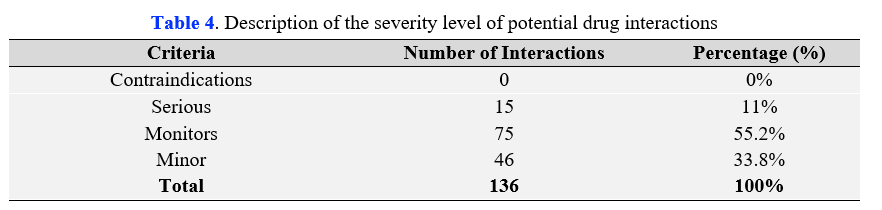
Pneumonia patients with complex diseases require a variety of drugs so the possibility of drug interactions also increases. This study aims to determine patient characteristics, potential drug interactions, severity, description of the type of drug and number of interacting drugs, as well as the relationship between patient characteristics and drug interactions. This type of research is a retrospective analytical descriptive study. The research sample was the medical records of patients diagnosed with pneumonia who met the inclusion criteria. Determination of drug interactions using the Medscape application. The analysis uses a correlation test to determine the relationship between the number of drugs and comorbidities with potential drug interactions. The characteristics of patients based on age are 46-65 years (36%), the majority of gender is male (52%), the number of drugs most frequently used is ≥ 5 types of drugs (94%), the predominant comorbidity is asthma (19.3%). The number of potential drug interactions occurred in 60 patients (67%) out of a total of 90 pneumonia patients. The highest level of severity of potential drug interactions was 55.2%. The type and number of drugs that interacted most were dexamethasone with omeperazole (13.2%). The results of the Chi Square correlation test obtained a significance value of 0.00 where the significance result was <0.05, so it was concluded that the number of drugs used and comorbidities with drug interactions was correlated with an R value of 0.477, which means the correlation between the number of drugs used and comorbidities has a moderate level of correlation.
References
Agustin, O. A., & Fitrianingsih, F. (2021). Kajian Interaksi Obat Berdasarkan Kategori Signifikansi Klinis Terhadap Pola Peresepan Pasien Rawat Jalan Di Apotek X Jambi. Electronic Journal Scientific of Environmental Health And Disease, 1(1). https://doi.org/10.22437/esehad.v1i1.10759
Agustina, E., Oktavia, S., Julianti, M., & Wahyuni, F. (2023). Analisis DRPS (Drug Related Problems) Pada Pasien Geriatri Pneumonia di Instalasi Rawat Inap RSUP Dr. M. Djamil Padang. Jurnal Farmasi Higea, 15(1), 84. https://doi.org/10.52689/higea.v15i1.543
Azyenela, L., Aria, M., & Aristya, L. (2022). The study of drug interaction on pneumonia patients at RSUP Dr. M. Djamil Padang. Jurnal Ilmiah Farmasi, Special Is, 128–135. https://doi.org/10.20885/jif.specialissue2022.art15
Bhagavathula, A. S., Berhanie, A., Tigistu, H., Abraham, Y., Getachew, Y., Khan, T. M., & Unakal, C. (2014).
Prevalence of potential drug–drug interactions among internal medicine ward in University of Gondar Teaching Hospital, Ethiopia. Asian Pacific Journal of Tropical Biomedicine, 4, S204–S208. https://doi.org/10.12980/APJTB.4.2014C1172
Dinkes Cirebon. (2020). Profil Kesehatan Kabupaten Cirebon Tahun 2020. Dinas Kesehatan Kabupaten Cirebon.
Efliana, M., Fadraersada, J., & Rijai, L. (2016, November 1). Karakteristik dan Pengobatan Pasien Pneumona di Instalasi Rawat Inap RSUD Abdul Wahab Sjahranie Samarinda. Proceeding of the 4th Mulawarman Pharmaceuticals Conferences. https://doi.org/10.25026/mpc.v4i1.183
Erviana, R. (2018). Potensi Interaksi Obat Pada Pasien Terdiagnosa Pneumonia Di Rumah Sakit Paru Respira Yogyakarta. PHARMACY: Jurnal Farmasi Indonesia (Pharmaceutical Journal of Indonesia), 14(2), 199. https://doi.org/10.30595/pharmacy.v14i2.1989
Farida, Y. (2022). Studi Potensi Interaksi Antibiotik Dengan Obat Lain Pada Peresepan Pasien Pneumonia Di Intensive Care Unit. Jurnal Farmasi Indonesia, 19(1), 1–13. https://doi.org/10.31001/jfi.v19i1.816
Farida, Y., & Soleqah, A. D. (2016). Identification Of Potentialantibiotics – Drugs interaction On Pneumonia Prescription. JPSCR : Journal of Pharmaceutical Science and Clinical Research, 1(2), 90. https://doi.org/10.20961/jpscr.v1i2.1940
Fatin, M. N. A., & Pasha, E. Y. M. (2021). Potensi Interaksi Obat Dengan Obat Pada Pasien Dewasa Dengan Pneumonia. Journal of Pharmacopolium, 4(2). https://doi.org/10.36465/jop.v4i2.746
Fitriani, S. W., Mutiara, R., Malik, A., & Andriastuti, M. (2016). Angka Kejadian dan Faktor yang Memengaruhi Potensi Interaksi Obat dengan Obat pada Pasien Leukemia Akut Anak yang Menjalani Rawat Inap. Sari Pediatri, 18(2), 129. https://doi.org/10.14238/sp18.2.2016.129-36
Getachew, H., Assen, M., Dula, F., & Bhagavathula, A. S. (2016). Potential drug–drug interactions in pediatric wards of Gondar University Hospital, Ethiopia: A cross sectional study. Asian Pacific Journal of Tropical Biomedicine, 6(6), 534–538. https://doi.org/10.1016/j.apjtb.2016.04.002
Kemenkes RI. (2006). Profil Kesehatan Indonesia Tahun 2022. Kemenkes RI.
Reyaan, I. B. M., Kuning, C., & Adnyana, I. K. (2021). Studi Potensi Interaksi Obat pada Resep Polifarmasi di Dua Apotek Kota Bandung. Jurnal Manajemen Dan Pelayanan Farmasi (Journal of Management and Pharmacy Practice), 11(3), 145. https://doi.org/10.22146/jmpf.56931
Sari, Yuswar, M. A., & Untari, E. K. (2019). Kajian Interaksi Antibiotik Pada Penderita Pneumonia Rawat Inap Di RSUD DR.Soedarso Pontianak Periode Januari-Juni 2019. Jurnal Mahasiswa Farmasi Fakultas Kedokteran UNTAN, 27, 1–6. https://jurnal.untan.ac.id/index.php/jmfarmasi/article/view/44647